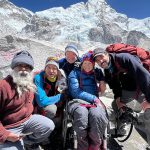
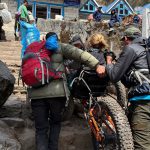
An incredible hike with an amazing group of people. Badri managed to get us in and out of Lukla on days when we thought flights may not be possible and he tried his very best to accommodate the needs of the group. The team of porters supporting Karen Darke were out of this world and did an incredible job, with big smiles. Wonderful people. The trek itself was incredible and we had fantastic weather during the whole trip. Although the ‘B Team’ snail ed it, we had an excellent adventure thanks to Badri and his very supportive team.
Teahouse Treks
Authentic Nepal Trekking
Annapurna Nar Phu Valley Trek: A Journey into the Forbidden Valleys – 18 Days
The Annapurna Nar Phu Valley Trek is a remote and adventurous 18-day trekking package in Nepal that takes you deep into the hidden valleys of Nar and Phu in the Annapurna region. This trek is perfect for travelers who want a wild Himalayan journey, ancient Tibetan-influenced villages, dramatic canyons, high mountain passes, Buddhist monasteries, and a less-crowded trekking experience.
Known as “A Journey into the Forbidden Valleys,” the Annapurna Nar Phu Valley Trek explores one of Nepal’s restricted trekking areas in the Manang district. The trail leaves the classic Annapurna Circuit route from Koto and enters the isolated valleys of Meta, Phu Gaon, Nar Phedi, and Nar Gaon before crossing the high Kang La Pass. Many 18-day Nar Phu itineraries also connect with the Annapurna Circuit and cross Thorong La Pass at 5,416m, making it a powerful adventure through two high Himalayan passes.
This trek offers spectacular views of Annapurna II, Himlung Himal, Gangapurna, Tilicho Peak, Pisang Peak, Chulu peaks, Manaslu, and the Annapurna range. The route passes through deep gorges, stone villages, yak pastures, dry alpine valleys, prayer walls, ancient monasteries, and traditional settlements where Tibetan Buddhist culture is still strongly preserved.
The Annapurna Nar Phu Valley Trek – 18 Days is suitable for experienced trekkers, fit adventure travelers, photographers, mountain lovers, cultural explorers, and travelers from the USA, Australia, Canada, Europe, Asia, and worldwide who want a guided restricted-area trekking package with local experts.
Why Choose Annapurna Nar Phu Valley Trek?
The Annapurna Nar Phu Valley Trek is one of the best remote treks in Nepal for travelers who want to go beyond the popular trekking trails. It combines the hidden Nar and Phu valleys with the classic Annapurna Circuit route, giving trekkers a special mix of wilderness, culture, high passes, and dramatic Himalayan landscapes.
This trek is different from short and easy Annapurna treks. It is more adventurous, more remote, and more culturally unique. The trail reaches ancient villages where stone houses, chortens, mani walls, monasteries, and yak herding traditions show the strong Tibetan Buddhist influence of the region.
This trek is ideal for travelers looking for:
An 18-day remote Nepal trekking package
A restricted-area trek in the Annapurna region
A journey into Nar and Phu hidden valleys
A guided Nar Phu Valley Trek with licensed local experts
A combination of Nar Phu Valley and Annapurna Circuit
A challenging trek with Kang La Pass and Thorong La Pass
Traditional Tibetan-influenced villages and monasteries
A less-crowded alternative to the classic Annapurna Circuit
High mountain views of Annapurna, Himlung, Gangapurna, and Manaslu
A package for experienced trekkers from the USA, Australia, Canada, Europe, Asia, and worldwide
Annapurna Nar Phu Valley Trek Highlights
Explore the restricted Nar and Phu valleys of the Annapurna region
Visit ancient Tibetan-influenced villages such as Phu Gaon and Nar Gaon
Cross Kang La Pass, usually listed around 5,306m–5,322m depending on source and route measurement
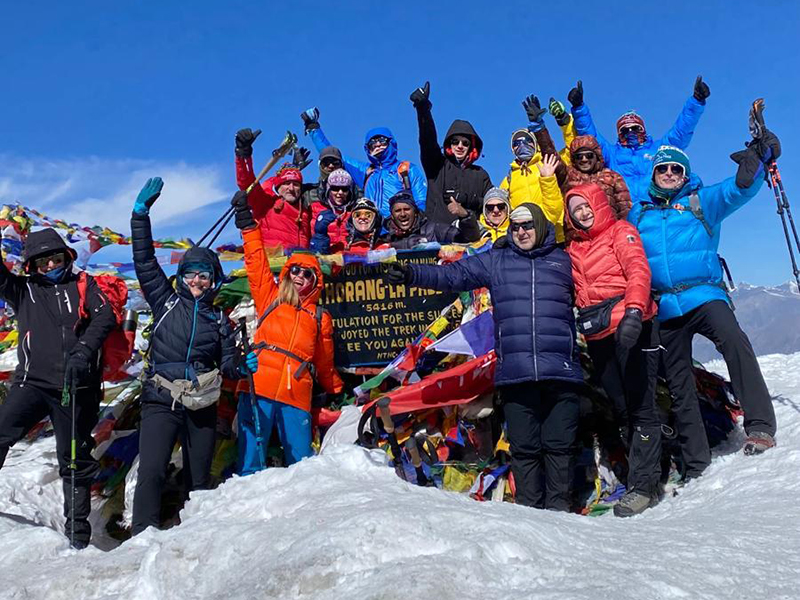
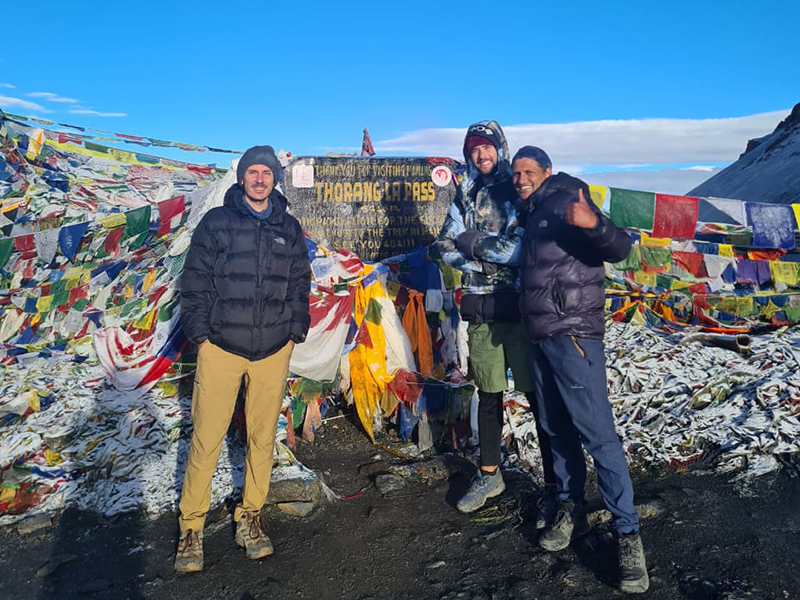
Cross Thorong La Pass at 5,416m, one of the highest trekking passes in Nepal
Walk through dramatic gorges, dry valleys, alpine landscapes, and yak pastures
Experience Buddhist culture, chortens, prayer flags, mani walls, and monasteries
Enjoy views of Annapurna II, Himlung Himal, Gangapurna, Tilicho Peak, Pisang Peak, Chulu peaks, and Manaslu
Follow a less-crowded trail away from the main Annapurna route
Visit Manang, Muktinath, Jomsom, and Pokhara
Experience both remote wilderness trekking and classic Annapurna Circuit scenery
Stay in local tea houses and mountain lodges
Perfect for experienced trekkers looking for a challenging Himalayan journey
Best Time for Annapurna Nar Phu Valley Trek
The best time for the Annapurna Nar Phu Valley Trek is spring and autumn.
Spring, from March to May, is a beautiful trekking season with warmer days, blooming rhododendrons in lower sections, and generally good mountain views. The higher valleys may still be cold, especially around Nar, Phu, Kang La Pass, and Thorong La Pass.
Autumn, from September to November, is the most popular season for this trek. The weather is usually clearer after the monsoon, the mountain views are sharp, and the high passes are generally more stable than in the deep winter months. Nepal Tourism Board notes that post-monsoon weather tends to be clearer, while winter is colder with shorter days.
This trek can also be possible in December and February for experienced trekkers with proper winter gear, but snow and ice may affect Kang La Pass and Thorong La Pass. The monsoon season from June to August is more difficult because of rain in the lower areas, landslides, cloudy weather, and slippery trails, although the upper Manang region receives less rain than many other parts of Nepal.
Annapurna Nar Phu Valley Trek Difficulty
The Annapurna Nar Phu Valley Trek is a challenging trek. It is more demanding than Annapurna Base Camp, Mardi Himal, or Ghorepani Poon Hill because it enters remote high-altitude valleys and crosses high mountain passes.
Trekkers should be ready for long walking days, steep climbs, rocky trails, narrow paths, cold weather, basic mountain accommodation, and high altitude. The route crosses Kang La Pass and, in this 18-day version, continues over Thorong La Pass at 5,416m. Commercial trekking operators commonly describe this version as strenuous because it combines Nar Phu Valley, Kang La Pass, and Thorong La Pass in one itinerary.
Previous trekking experience is highly recommended. Good physical fitness, proper acclimatization, warm clothing, strong trekking boots, and travel insurance covering high-altitude emergency evacuation are very important.
Annapurna Nar Phu Valley Trek Permits
The Annapurna Nar Phu Valley Trek requires special permits because Nar Phu lies inside a restricted trekking area. Nepal’s Department of Immigration states that restricted areas are highly regulated and trekking in those areas requires a trekking permit from the Department of Immigration through authorized agencies.
For Nar Phu, the Department of Immigration lists the restricted area under Manang Narpa Rural Municipality and Nasho Rural Municipality. The official restricted-area permit fee is USD 100 per person per week from September to November, plus USD 15 per person per day beyond one week. From December to August, the fee is USD 75 per person per week, plus USD 15 per person per day beyond one week.
Trekkers also need the Annapurna Conservation Area Permit / ACAP because the trek is inside the Annapurna Conservation Area. NTNC lists the ACAP entry fee as NPR 3,000 for foreigners and NPR 1,000 for SAARC nationals, tax included.
A TIMS Card and licensed trekking guide may also apply under Nepal Tourism Board’s revised TIMS provision for protected-area trekking routes. NTB states that specific protected-area treks require trekkers to be accompanied by a licensed trekking guide and carry a trekking-agency-issued TIMS Card.
Your trekking agency should arrange all required permits before the trek begins. Permit rules can change, so the final permit details should always be checked before booking.
Trip Itinerary
Outline Itinerary
- Day 01: Arrive in Kathmandu
- Day 02: Kathmandu Sightseeing, Permit Preparation and Trek Briefing
- Day 03: Drive from Kathmandu to Jagat
- Day 04: Trek from Jagat to Dharapani
- Day 05: Trek from Dharapani to Koto
- Day 06: Trek from Koto to Meta
- Day 07: Trek from Meta to Phu Gaon
- Day 08: Acclimatization and Exploration Day at Phu Gaon
- Day 09: Trek from Phu Gaon to Nar Phedi
- Day 10: Trek from Nar Phedi to Nar Gaon
- Day 11: Acclimatization Day at Nar Gaon
- Day 12: Cross Kang La Pass and Trek to Ngawal
- Day 13: Trek from Ngawal to Manang
- Day 14: Trek from Manang to Yak Kharka
- Day 15: Trek from Yak Kharka to Thorong Phedi / High Camp
- Day 16: Cross Thorong La Pass and Trek to Muktinath
- Day 17: Drive from Muktinath to Pokhara via Jomsom
- Day 18: Drive or Fly from Pokhara to Kathmandu / Final Departure
Details Itinerary
Day 01: Arrive in Kathmandu
After your arrival at Tribhuvan International Airport in Kathmandu, our representative will welcome you and transfer you to your hotel. You can rest after your international flight and prepare for your Annapurna Nar Phu Valley Trek.
In the evening, there will be a short trip briefing. Your trekking guide will explain the route, walking hours, accommodation, meals, permits, restricted-area rules, altitude safety, weather conditions, packing list, and important trekking information.
Altitude: Kathmandu – 1,300m / 4,260ft
Transfer Time: Approx. 30–45 minutes
- Lodging: Hotel in Kathmandu
- Inclusions: Welcome Dinner
Day 02: Kathmandu Sightseeing, Permit Preparation and Trek Briefing
Today is a preparation day in Kathmandu. After breakfast, you can visit famous cultural sites such as Kathmandu Durbar Square, Swayambhunath, Pashupatinath, or Boudhanath depending on time and interest.
This day is also important for restricted-area permit preparation. Your agency will check your passport, visa, insurance details, photographs, and trekking documents. Your guide will also help check your trekking gear. If anything is missing, you can buy or rent trekking equipment in Kathmandu.
Altitude: Kathmandu – 1,300m / 4,260ft
Activity Time: Approx. 4–5 hours sightseeing and preparation
- Lodging: Hotel in Kathmandu
- Inclusions: Breakfast
Day 03: Drive from Kathmandu to Jagat
After breakfast, you will begin the long scenic drive from Kathmandu to Jagat. The road follows river valleys, hills, towns, terraced fields, and countryside landscapes.
You will first drive toward Besisahar, the gateway to the Annapurna Circuit, and then continue by local jeep or private vehicle toward Jagat depending on road conditions. The drive is long but gives a good introduction to Nepal’s mid-hill landscapes.
Altitude: Jagat – approx. 1,300m / 4,265ft
Drive Time: Approx. 8–10 hours
- Lodging: Tea House / Lodge
- Inclusions: Breakfast, Lunch, Dinner
Day 04: Trek from Jagat to Dharapani
After breakfast, the trekking journey begins. The trail follows the Marsyangdi River valley and passes through villages, forests, waterfalls, suspension bridges, and rocky paths.
You will walk through settlements such as Chamje, Tal, and Karte before reaching Dharapani. This section is part of the classic Annapurna Circuit trail and gives a beautiful mix of river scenery, green hills, and local village life.
Altitude: Dharapani – approx. 1,860m / 6,102ft
Trek Time: Approx. 6–7 hours
- Lodging: Tea House / Lodge
- Inclusions: Breakfast, Lunch, Dinner
Day 05: Trek from Dharapani to Koto
Today, you will continue trekking along the Annapurna Circuit route toward Koto. The trail passes through pine forests, small settlements, waterfalls, and mountain viewpoints.
As you gain altitude, the scenery becomes more dramatic. You may enjoy views of Annapurna II, Lamjung Himal, and surrounding peaks along the way. Koto is the entry point toward the restricted Nar Phu Valley route. Your permits will be checked here before entering the hidden valley section.
Altitude: Koto – approx. 2,600m / 8,530ft
Trek Time: Approx. 5–6 hours
- Lodging: Tea House / Lodge
- Inclusions: Breakfast, Lunch, Dinner
Day 06: Trek from Koto to Meta
After permit checking at Koto, you will leave the main Annapurna Circuit trail and enter the remote Nar Phu Valley route. The trail follows the Nar Khola through narrow gorges, pine forests, suspension bridges, and rugged landscapes.
This is one of the most exciting days of the trek because the route becomes quieter and more wild. You will pass small resting places, waterfalls, and forested sections before climbing toward Meta. Meta is a remote highland settlement with wide views of the surrounding mountains and valleys.
Altitude: Meta – approx. 3,560m / 11,680ft
Trek Time: Approx. 7–8 hours
- Lodging: Tea House / Lodge
- Inclusions: Breakfast, Lunch, Dinner
Day 07: Trek from Meta to Phu Gaon
After breakfast, you will trek deeper into the forbidden valleys toward Phu Gaon. The trail passes through dry alpine landscapes, eroded cliffs, open valleys, chortens, mani walls, and small traditional settlements.
As you approach Phu, the landscape becomes more Tibetan in character. Phu Gaon is an ancient stone village located in a remote valley, surrounded by cliffs, high pastures, and mountain scenery. This village is one of the cultural highlights of the Annapurna Nar Phu Valley Trek.
Altitude: Phu Gaon – approx. 4,050m / 13,287ft
Trek Time: Approx. 6–7 hours
- Lodging: Tea House / Lodge
- Inclusions: Breakfast, Lunch, Dinner
Day 08: Acclimatization and Exploration Day at Phu Gaon
Today is an acclimatization day in Phu Gaon. Because the trek has reached above 4,000 meters, taking time to adjust is important for safety and comfort.
You can explore the ancient village, visit nearby monasteries, observe local lifestyle, and enjoy views of the surrounding Himalayan landscape. Depending on condition and interest, your guide may arrange a short hike to a nearby viewpoint or monastery area. This day helps your body prepare for the higher sections of the trek.
Altitude: Phu Gaon – approx. 4,050m / 13,287ft
Activity Time: Approx. 2–4 hours light exploration
- Lodging: Tea House / Lodge
- Inclusions: Breakfast, Lunch, Dinner
Day 09: Trek from Phu Gaon to Nar Phedi
After breakfast, you will leave Phu Gaon and descend back through the valley. The trail passes through dry landscapes, ancient chortens, river crossings, and open mountain scenery.
You will continue toward Nar Phedi, a peaceful overnight stop below Nar village. Some itineraries stay near Nar Phedi monastery, where the atmosphere is quiet and spiritual. This is a special day to experience the remote feeling of the Nar Phu region.
Altitude: Nar Phedi – approx. 3,490m / 11,450ft
Trek Time: Approx. 5–6 hours
- Lodging: Basic Tea House / Monastery Lodge
- Inclusions: Breakfast, Lunch, Dinner
Day 10: Trek from Nar Phedi to Nar Gaon
Today, you will climb from Nar Phedi to Nar Gaon. The trail is mostly uphill and passes prayer flags, chortens, and wide highland scenery.
Nar Gaon is another beautiful Tibetan-influenced village in the restricted valley. The village is known for stone houses, Buddhist culture, yak pastures, and traditional mountain lifestyle. After arrival, you can rest and explore the village slowly.
Altitude: Nar Gaon – approx. 4,110m / 13,484ft
Trek Time: Approx. 3–4 hours
- Lodging: Tea House / Lodge
- Inclusions: Breakfast, Lunch, Dinner
Day 11: Acclimatization Day at Nar Gaon
Today is another important acclimatization day. Since you will cross Kang La Pass the next day, this rest day helps your body adjust to the altitude and improves safety.
You can explore Nar village, visit local monasteries, walk around the nearby viewpoints, and enjoy the peaceful highland environment. Your guide will also check the weather and trail condition for the Kang La Pass crossing.
Altitude: Nar Gaon – approx. 4,110m / 13,484ft
Activity Time: Approx. 2–4 hours light exploration
- Lodging: Tea House / Lodge
- Inclusions: Breakfast, Lunch, Dinner
Day 12: Cross Kang La Pass and Trek to Ngawal
Today is one of the most challenging and rewarding days of the trek. You will start early in the morning and climb toward Kang La Pass. The trail can be steep, rocky, snowy, and physically demanding depending on season and weather.
From the top of Kang La Pass, you can enjoy breathtaking views of Annapurna II, Gangapurna, Tilicho Peak, Pisang Peak, Chulu peaks, and the surrounding Himalayan range. After enjoying the views, you will descend carefully toward Ngawal, a beautiful village on the upper Annapurna Circuit route.
Altitude: Kang La Pass – approx. 5,306m–5,322m / 17,408ft–17,460ft; Ngawal – approx. 3,660m / 12,008ft
Trek Time: Approx. 8–9 hours
- Lodging: Tea House / Lodge
- Inclusions: Breakfast, Lunch, Dinner
Day 13: Trek from Ngawal to Manang
After breakfast, you will walk from Ngawal toward Manang. The trail offers beautiful views of Annapurna II, Annapurna III, Gangapurna, Tilicho Peak, and surrounding mountains.
Manang is one of the main villages on the Annapurna Circuit route. It has better facilities than the remote Nar Phu section and is a good place to rest after crossing Kang La Pass. You can explore the village, visit the local monastery, or enjoy views of Gangapurna Lake and the surrounding peaks.
Altitude: Manang – approx. 3,540m / 11,614ft
Trek Time: Approx. 4–5 hours
- Lodging: Tea House / Lodge
- Inclusions: Breakfast, Lunch, Dinner
Day 14: Trek from Manang to Yak Kharka
Today, you will leave Manang and continue along the Annapurna Circuit route toward Yak Kharka. The trail climbs gradually through dry alpine landscapes, yak grazing areas, and high mountain scenery.
You should walk slowly because the route is now heading toward Thorong La Pass. The day is not very long, which helps with altitude adjustment before moving higher.
Altitude: Yak Kharka – approx. 4,050m / 13,287ft
Trek Time: Approx. 4–5 hours
- Lodging: Tea House / Lodge
- Inclusions: Breakfast, Lunch, Dinner
Day 15: Trek from Yak Kharka to Thorong Phedi / High Camp
After breakfast, you will trek toward Thorong Phedi. The trail passes through high alpine terrain, narrow paths, and landslide-prone sections where careful walking is important.
Depending on weather, trail condition, and group fitness, your guide may stop at Thorong Phedi or continue to High Camp. Thorong Phedi is the safer and more common overnight stop for many trekkers before crossing Thorong La Pass. High Camp is higher and colder but shortens the next day’s climb.
Altitude: Thorong Phedi – approx. 4,450m / 14,600ft; High Camp – approx. 4,880m / 16,010ft
Trek Time: Approx. 4–6 hours
- Lodging: Tea House / Lodge
- Inclusions: Breakfast, Lunch, Dinner
Day 16: Cross Thorong La Pass and Trek to Muktinath
Today is the longest and highest day of the trek. You will start very early in the morning and climb toward Thorong La Pass. The trail is cold, steep, and challenging, but the views from the pass are unforgettable.
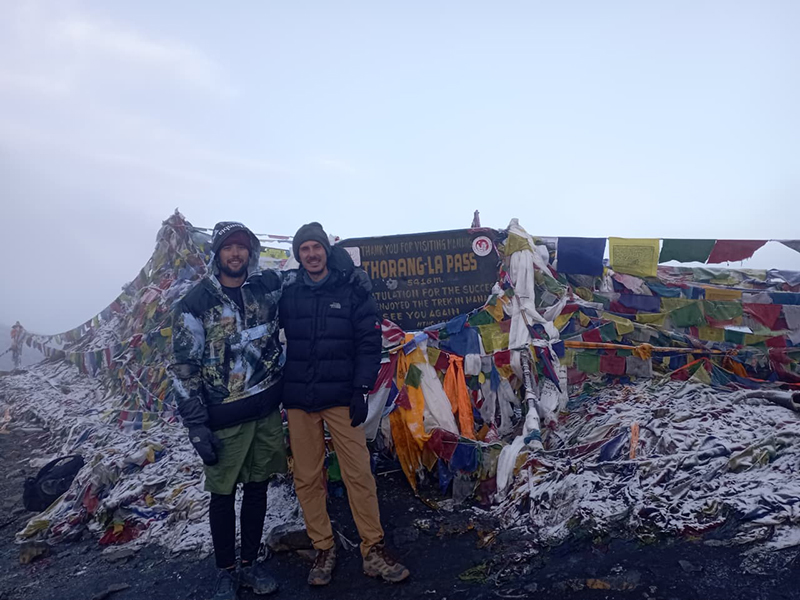
Thorong La Pass is usually listed at 5,416m / 17,769ft and is one of the most famous high passes on the Annapurna Circuit route. After reaching the pass, you will descend toward Muktinath, a sacred pilgrimage site for both Hindus and Buddhists.
After a long descent, you will reach Muktinath and rest at a local lodge. This day is physically demanding, but it is one of the biggest achievements of the entire journey.
Altitude: Thorong La Pass – 5,416m / 17,769ft; Muktinath – approx. 3,800m / 12,467ft
Trek Time: Approx. 8–10 hours
- Lodging: Tea House / Lodge
- Inclusions: Breakfast, Lunch, Dinner
Day 17: Drive from Muktinath to Pokhara via Jomsom
After breakfast, you will drive from Muktinath toward Jomsom and continue to Pokhara. The journey passes through the Kali Gandaki valley, dry Mustang landscapes, river valleys, villages, and changing mountain scenery.
Depending on road and weather conditions, the drive can be long and bumpy. After arrival in Pokhara, you can rest at your hotel, enjoy a hot shower, walk around Lakeside, and celebrate the successful completion of the Annapurna Nar Phu Valley Trek.
Altitude: Pokhara – 820m / 2,690ft
Drive Time: Approx. 8–10 hours depending on road condition
- Lodging: Hotel in Pokhara
- Inclusions: Breakfast, Lunch
Day 18: Drive or Fly from Pokhara to Kathmandu / Final Departure
After breakfast, you will return from Pokhara to Kathmandu by tourist bus, private vehicle, or flight. If your international flight is later in the evening, airport transfer can be arranged after arrival in Kathmandu. If needed, you can add one extra night in Kathmandu for a more relaxed departure.
Your Annapurna Nar Phu Valley Trek – 18 Days ends today with unforgettable memories of restricted valleys, ancient villages, high passes, Tibetan Buddhist culture, and the remote Annapurna Himalaya.
Altitude: Kathmandu – 1,300m / 4,260ft
Travel Time: Drive approx. 6–7 hours or flight approx. 25–30 minutes
- Lodging: Not Included unless extra night is booked
- Inclusions: Breakfast
Cost Details
Cost Includes
- Airport arrival and departure transfer
- Hotel accommodation in Kathmandu
- Hotel accommodation in Pokhara
- Kathmandu sightseeing assistance as per itinerary
- Restricted-area permit assistance for Nar Phu Valley
- Annapurna Conservation Area Permit assistance
- TIMS Card assistance if required under current rules
- Tea house / lodge accommodation during the tre
- Breakfast in Kathmandu and Pokhara
- Breakfast, lunch, and dinner during trekking days
- Licensed trekking guide
- Trekking staff support as per group size
- Porter support as per package policy
- Ground transportation as per itinerary
- Basic first aid support
- High-altitude safety guidance
- Farewell or completion dinner as per package policy
- Government taxes and official service charges as per package policy
Cost Excludes
- International airfare
- Nepal visa fee
- Travel insurance
- Personal trekking equipment
- Lunch and dinner in Kathmandu and Pokhara unless mentioned
- Drinks, snacks, hot shower, Wi-Fi, battery charging, and personal expenses during trek
- Tips for guide, porter, and trekking staff
- Extra hotel nights caused by early arrival, late departure, road delay, weather condition, or itinerary change
- Additional cost caused by landslide, snow, political strike, road blockage, flight delay, or natural events
- Emergency rescue, medical treatment, helicopter evacuation, or insurance claim cost
- Extra restricted-area permit cost caused by itinerary extension
- Any cost not mentioned in the Cost Includes section
FAQ
Annapurna Nar Phu Valley Trek
Is Annapurna Nar Phu Valley Trek good for beginners?
No, the Annapurna Nar Phu Valley Trek is not recommended for complete beginners. It is a challenging trek that enters remote restricted valleys and crosses high mountain passes. Previous trekking experience and good fitness are strongly recommended.
How many days is the Annapurna Nar Phu Valley Trek?
This package is an 18-day Annapurna Nar Phu Valley Trek including arrival in Kathmandu, permit preparation, trekking days, high pass crossings, return to Pokhara, and final return to Kathmandu.
What is the highest point of this trek?
The highest point of this 18-day itinerary is Thorong La Pass at 5,416m / 17,769ft. The trek also crosses Kang La Pass, usually listed around 5,306m–5,322m depending on the route source.
Do I need a restricted-area permit for Nar Phu Valley?
Yes. Nar Phu is a restricted trekking area. The Department of Immigration lists the Nar Phu restricted-area permit under Manang Narpa Rural Municipality and Nasho Rural Municipality, with seasonal permit fees.
How much is the Nar Phu restricted-area permit?
The official restricted-area permit fee is USD 100 per person per week from September to November and USD 75 per person per week from December to August. Extra days beyond one week cost USD 15 per person per day.
Do I need ACAP for Annapurna Nar Phu Valley Trek?
Yes. The trek lies inside the Annapurna Conservation Area, so trekkers need the ACAP permit. NTNC lists the ACAP entry fee as NPR 3,000 for foreigners and NPR 1,000 for SAARC nationals, tax included.
Is a guide required for Nar Phu Valley Trek?
Yes, a licensed guide and agency-arranged trekking permit are strongly required for this restricted-area trek. Nepal’s Department of Immigration states that restricted areas are regulated and trekking permits are issued through authorized agencies.
What is the best time for Annapurna Nar Phu Valley Trek?
The best time is spring from March to May and autumn from September to November. Autumn usually offers clearer mountain views, while spring is warmer and beautiful in the lower forest sections.
What mountains can I see during this trek?
You can see Annapurna II, Gangapurna, Tilicho Peak, Pisang Peak, Chulu peaks, Himlung Himal, Manaslu, Dhaulagiri, and other peaks depending on the route section and weather.
How difficult is the Annapurna Nar Phu Valley Trek?
This trek is challenging to strenuous. It includes long walking days, high altitude, remote valleys, steep climbs, cold conditions, Kang La Pass, and Thorong La Pass. Good fitness and preparation are necessary.
What kind of accommodation is available during the trek?
Accommodation is mainly in tea houses and mountain lodges. In remote sections such as Meta, Phu, Nar Phedi, and Nar, facilities are basic compared to popular routes like Annapurna Base Camp or Ghorepani Poon Hill.
Do I need travel insurance?
Yes. Travel insurance is strongly recommended and should cover trekking above 5,000 meters, emergency rescue, medical treatment, and helicopter evacuation.
Can I book a private Annapurna Nar Phu Valley Trek?
Yes. This package can be arranged as a private guided trek depending on your travel date, group size, budget, and fitness level.
Can I customize this 18-day itinerary?
Yes. The itinerary can be customized. You can make it shorter by ending after Kang La Pass and returning through Besisahar, or make it longer by adding Tilicho Lake, extra acclimatization days, Pokhara sightseeing, or Kathmandu sightseeing.
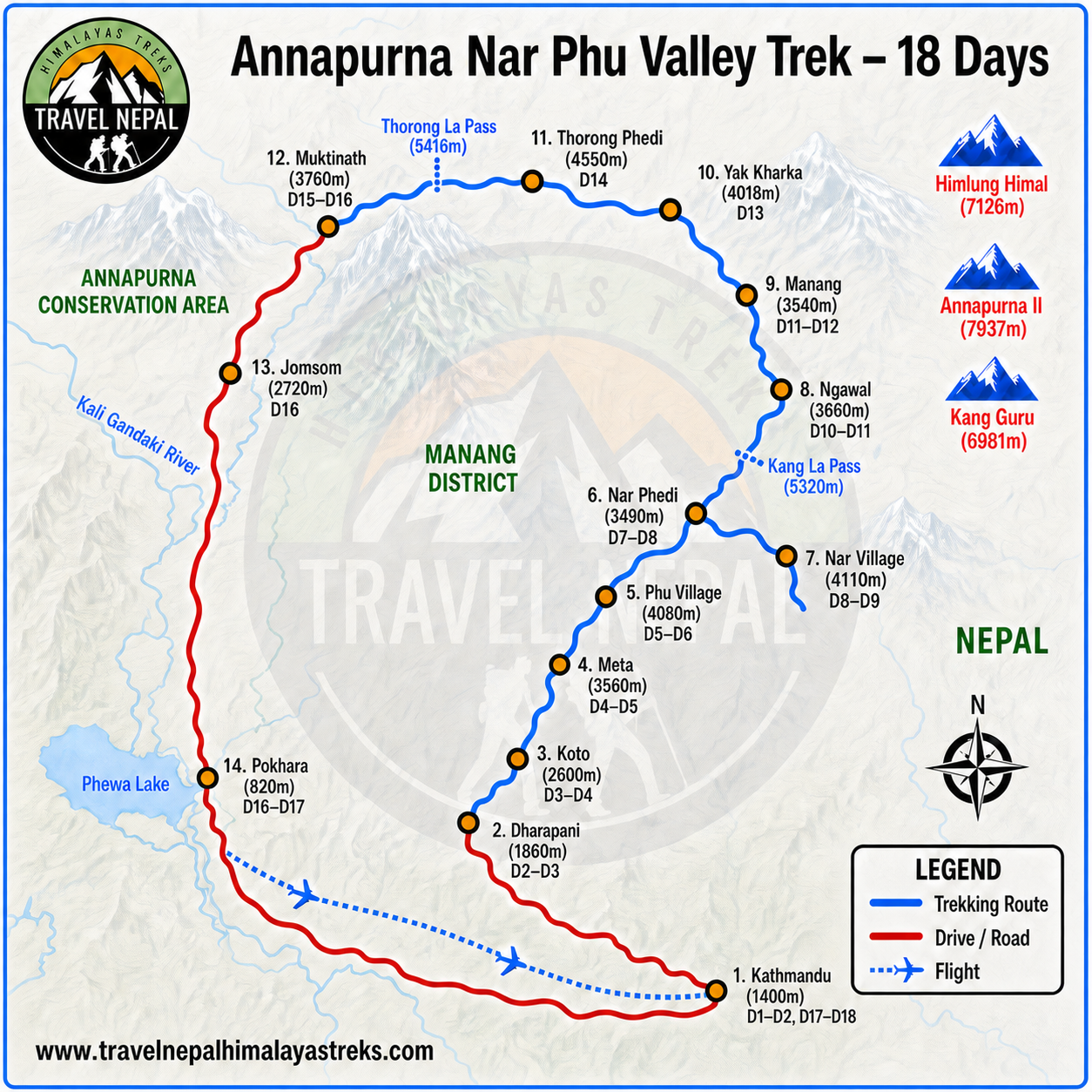
Route Map
Gallery
Client Reviews
Mitchedberg
Vicky S
Date of experience: March 2025
Clare B
Date of experience: March 2025
An amazing experience – went trekking with 14 others in March / April 2025 and had a wonderful time. A big thank you to Badri and his crew for taking care of every logistical detail; flights, hotels, transportation in Kathmandu, transportation to and from the airport, money exchanges, restaurant reservations, sightseeing, optimal route pacing, gear transportation, and 100 other small details that would have left me flummoxed.
He and his team allow for a trek that’s as simplified as possible, you can focus your energy on getting to base camp, and they do everything else. They even bring you hot towels and lemon ginger tea at the end of each day (every morning too). I can’t say enough good things about the porters / guides, they were unbelievable, true heroes of our trip. We had some very unique challenges in our group, and without expert guides and porters we would absolutely not have had the same high quality experience. When I go back to Nepal for a second trek, I’m calling Badri. Badri is the guide you want – generous, personal, and you can tell he and his team deeply care about the well-being of their clients.
One more thing: Not once, but twice, Badri got our entire group flown from Kathmandu to Lukla (and back) on days when the weather was uncooperative. Both times, there was only a brief window when the clouds cleared — just enough for a single plane to make the journey — and guess whose plane was first in line? Even more impressive: while we were waiting at the airport, Badri already had a backup helicopter option lined up, just in case the planes didn’t fly. This kind of foresight and preparation gave us total peace of mind.