An incredible hike with an amazing group of people. Badri managed to get us in and out of Lukla on days when we thought flights may not be possible and he tried his very best to accommodate the needs of the group. The team of porters supporting Karen Darke were out of this world and did an incredible job, with big smiles. Wonderful people. The trek itself was incredible and we had fantastic weather during the whole trip. Although the ‘B Team’ snail ed it, we had an excellent adventure thanks to Badri and his very supportive team.
Teahouse Treks
Authentic Nepal Trekking
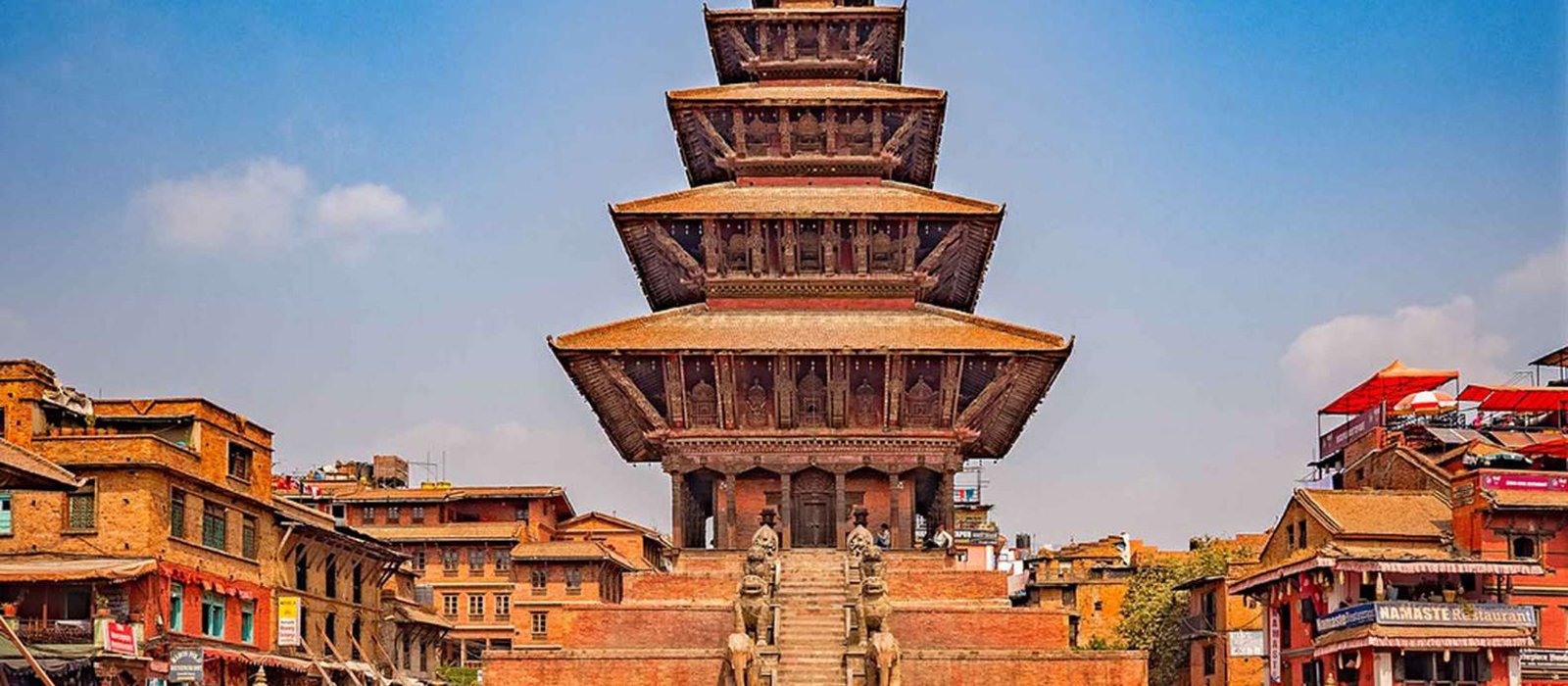
Kathmandu City Day Tour Overview
The Kathmandu City Day Tour is a rich and rewarding 1-day cultural sightseeing package that takes you through the most extraordinary heritage sites in one of Asia’s most fascinating cities. In a single day, you move between ancient royal courtyards, sacred cremation ghats, hilltop Buddhist stupas, and one of the great pilgrimage sites of the Buddhist world — all within a few kilometres of each other in the Kathmandu Valley.
Kathmandu is not just a stopover on the way to the mountains. The valley is home to seven UNESCO World Heritage Sites — more concentrated in one place than almost anywhere else on earth. The standard city tour covers four of them: Kathmandu Durbar Square, Swayambhunath Stupa, Pashupatinath Temple, and Boudhanath Stupa. Each one is a world unto itself.
This tour runs as a fully private guided experience — your own vehicle, your own guide, your own pace. It is ideal for first-time visitors to Nepal, families, couples, photographers, senior travelers, and anyone arriving before or departing after a trek who wants to make the most of their time in Kathmandu.
What You Will See
Kathmandu Durbar Square sits at the historic heart of the old city — a sprawling complex of temples, courtyards, and palaces built by the Malla kings between the 12th and 18th centuries. The square is still a living part of the city, not a museum piece. Look for Kumari Ghar — the house of the Living Goddess, a young girl chosen through ancient ritual to embody the goddess Taleju. If you are lucky, she may appear briefly at the carved wooden window above the courtyard.
Swayambhunath Stupa — known informally as the Monkey Temple — sits on a hill above the western edge of the city. The climb up the stone staircase is worth every step: at the top, the great white dome of the stupa is ringed by prayer wheels, butter lamps, and the watchful painted eyes of the Buddha gazing out in the four cardinal directions. The views over the Kathmandu Valley from the hilltop are the best in the city.
Pashupatinath Temple on the banks of the Bagmati River is Nepal’s most sacred Hindu site and one of the most important Shiva temples in the world. Non-Hindu visitors are not permitted inside the main sanctum, but the surrounding ghats offer an extraordinary window into the cycle of Hindu religious life — sadhus in ochre robes, cremation ceremonies conducted in the open air, pilgrims moving quietly along the riverbank. Bring respectful curiosity and ask your guide before photographing.
Boudhanath Stupa is one of the largest Buddhist stupas in the world and the spiritual centre of Kathmandu’s Tibetan community. The great white dome rises above a circular plaza ringed with monasteries, butter lamp shops, and cafes. Walk the kora — the clockwise circuit around the stupa — spinning the prayer wheels as you go, as thousands of pilgrims do every day. The atmosphere here is unlike anywhere else in Nepal.
Kathmandu City Day Tour Highlights
- Kathmandu Durbar Square — ancient royal courtyards and Malla-era temples
- Kumari Ghar — the house of Kathmandu’s Living Goddess
- Swayambhunath Stupa — panoramic views over the Kathmandu Valley
- Pashupatinath Temple — Nepal’s most sacred Hindu site on the Bagmati River
- Boudhanath Stupa — one of the largest Buddhist stupas in the world
- Seven UNESCO World Heritage Sites within the Kathmandu Valley
- Private guided tour — your own vehicle, guide, and pace
- Ideal before or after any Nepal trek
- Suitable for all ages including families and senior travelers
Best Time for Kathmandu City Day Tour
The Kathmandu City Day Tour can be done at any time of year — it is a year-round experience.
Autumn (September to November) and spring (March to May) offer the most pleasant conditions — clear skies, comfortable temperatures, and the best chance of mountain views from Swayambhunath. Early morning starts are always recommended: the heritage sites are quieter, the light is better for photography, and the air is cooler before the city fully wakes up.
Winter (December to February) is also perfectly fine for a city tour — daytime temperatures are comfortable and the crowds are thinner. The monsoon (June to August) brings afternoon rain but mornings are often clear; carry an umbrella or light rain jacket and adjust the timing accordingly.
What to Expect
This is an easy, comfortable day tour — no trekking experience required. You should be prepared for short walks, stone steps, temple staircases, and some uneven cobbled paths between heritage sites. Wear comfortable walking shoes and dress modestly for temple visits — shoulders and knees covered is the standard.
Carry drinking water, sunscreen, and a light jacket in cooler months. Keep some cash for personal purchases — the areas around Boudhanath and Swayambhunath have excellent shops for thangka paintings, singing bowls, prayer flags, and Tibetan crafts.
Always ask before photographing people, monks, religious ceremonies, or sacred objects. Your guide will lead you correctly through each site and explain what is and isn’t appropriate — follow their lead.
Entry Fees
Each heritage site charges a separate entry fee for foreign visitors. Based on current Nepal Tourism Board rates:
- Kathmandu Durbar Square — NPR 1,000 per person
- Swayambhunath Stupa — NPR 200 per person
- Pashupatinath Temple — NPR 1,000 per person
- Boudhanath Stupa — NPR 400 per person
Fees are subject to change — we will confirm current rates at the time of booking. Entry fees can be included or excluded from your package depending on your preference. Your guide, private vehicle, hotel pickup and drop-off are all included as standard.
Trip Itinerary
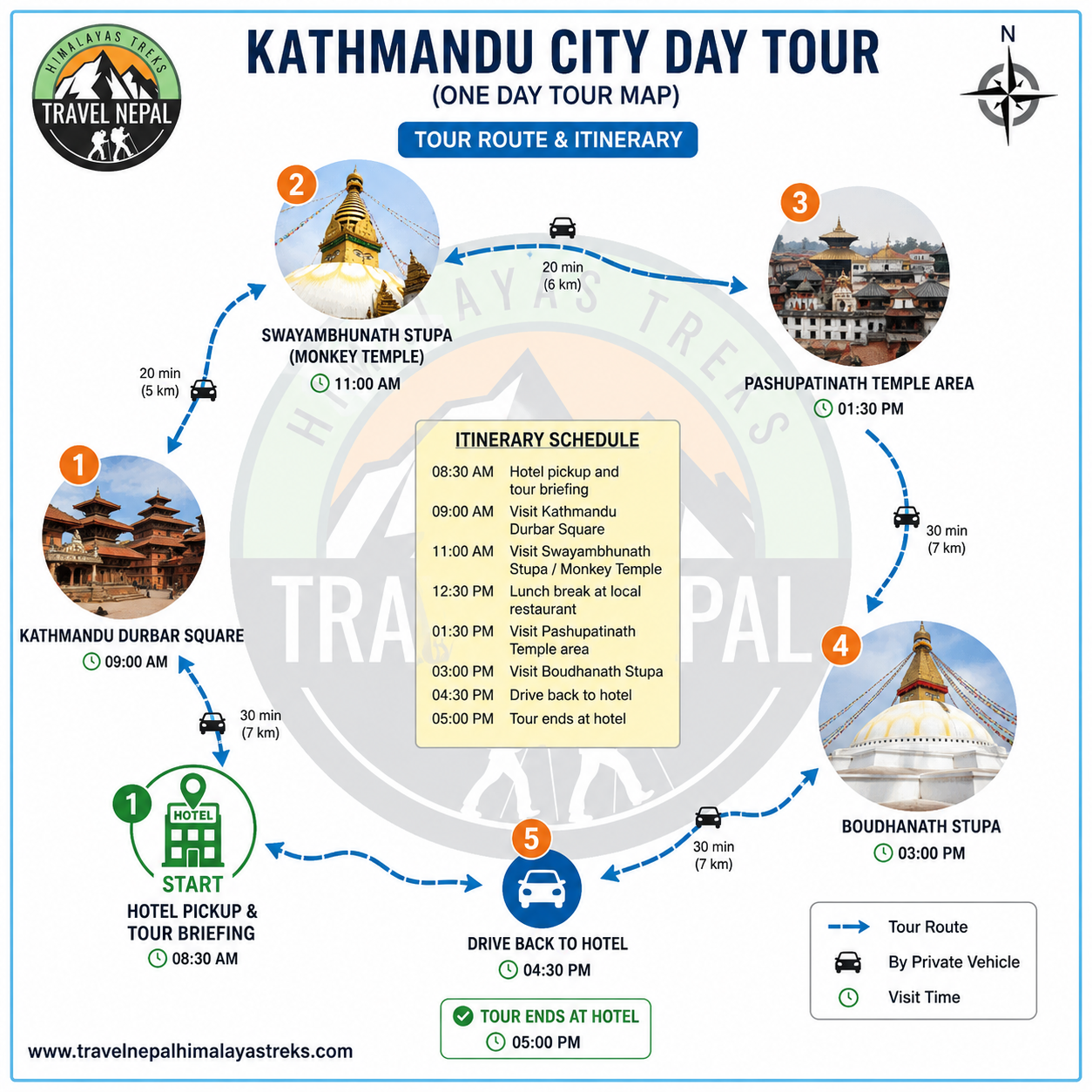
Outline Itinerary
• 08:30 AM: Hotel pickup and tour briefing
• 09:00 AM: Visit Kathmandu Durbar Square*
• 11:00 AM: Visit Swayambhunath Stupa / Monkey Temple*
• 12:30 PM: Lunch break at local restaurant ( paid at guests own expense)
• 01:30 PM: Visit Pashupatinath Temple area*
• 03:00 PM: Visit Boudhanath Stupa*
• 04:30 PM: Drive back to hotel
• 05:00 PM: Tour ends at hotel
Details Itinerary
Stop 01: Hotel Pickup and Tour Briefing
Hotel Pickup and Tour Briefing
Your guide and driver will meet you at your hotel after breakfast — pickup is typically between 8:30 and 9:00 AM, early enough to beat the crowds at the first sites and make the most of the morning light.
Before setting off, your guide will walk you through the day’s route, explain the cultural and religious significance of each site, cover photo rules and temple etiquette, and handle all entrance ticket logistics so you don’t have to think about it. From that point, the day is yours — private vehicle, private guide, your own pace.
- Pickup: Hotel inside Kathmandu city area
- Pickup Time: approx. 8:30–9:00 AM
- Transport: Private tourist vehicle with driver
- Lodging: Guide and vehicle as per package policy
Stop 02: Kathmandu Durbar Square
The first stop is Kathmandu Durbar Square — also known as Hanuman Dhoka Durbar Square — the ancient royal heart of the city. This sprawling complex of temples, courtyards, carved wooden windows, and stone statues was the seat of the Malla and early Shah kings, and it remains one of the finest examples of Newar architecture anywhere in the world.
You will explore the Hanuman Dhoka Palace area, the exterior of Taleju Temple, and the intricate courtyards that open one into another throughout the square. Look for Kumari Ghar — the house of the Living Goddess, a young girl chosen through ancient ritual to embody the goddess Taleju. If you are lucky, she may appear briefly at the elaborately carved wooden window above the courtyard. The square is still a living part of the city — locals pray here, festivals are held here, and the rhythm of daily Kathmandu life moves through it constantly.
- Main Attraction: Old royal square and Newar architecture
- Visit Time: approx. 1.5–2 hours
- Walking Level: Easy
- Entry Fee: Paid at site by guest
- Cultural Note: Respect Kumari House rules and photography restrictions
Stop 03: Swayambhunath Stupa / Monkey Temple
From Kathmandu Durbar Square, your driver takes you west across the city to Swayambhunath — the hilltop stupa that has watched over the Kathmandu Valley for more than 2,000 years. The climb up the stone staircase is steep enough to feel earned, and the resident monkeys that give the site its informal name will make themselves known on the way up.
At the top, the great white dome of the stupa rises above a terrace of prayer wheels, butter lamps, shrines, and fluttering prayer flags. The painted eyes of the Buddha gaze out in the four cardinal directions — watchful, serene, and unmistakably Nepali. The panoramic view over the Kathmandu Valley from up here is the best in the city — on a clear morning you can see the whole valley floor spreading out below, ringed by green hills and, in winter, snow-capped peaks on the horizon.
Swayambhunath is one of the few places in Nepal where Hindu and Buddhist worship coexist at the same site — a reflection of the deeply interwoven spiritual traditions of the valley. Walk the kora clockwise around the stupa, spinning the prayer wheels as you go.
- Main Attraction: Hilltop Buddhist stupa and valley views
- Visit Time: approx. 1 hour
- Walking Level: Easy to moderate — stairs to the top
- Entry Fee: Paid at site by guest
- Cultural Note: Walk clockwise around the stupa
Stop 04: Lunch Break at Local Restaurant
After Swayambhunath, your guide will take you to a local restaurant for lunch — a welcome pause in the middle of a full day of sightseeing.
The menu options are as varied as Kathmandu itself. Dal bhat — Nepal’s national dish of rice, lentil soup, and vegetable curry — is always a good choice, as are momos (dumplings), thukpa (noodle soup), a traditional Newari set, or vegetarian dishes. Most restaurants in the tourist areas also offer Indian and international options if you prefer something familiar.
- Meal: Lunch break. Meal is at guests own expense
- Duration: approx. 45 minutes to 1 hour
- Location: Kathmandu city area
Stop 05: Pashupatinath Temple
After lunch, your driver takes you east across the city to Pashupatinath — Nepal’s most sacred Hindu site and one of the most important Shiva temples in the world. The complex sits on the banks of the Bagmati River, a waterway considered as sacred to Hindus as the Ganges, and the atmosphere here is unlike anything else on the tour.
Non-Hindu visitors are not permitted inside the main sanctum — but the surrounding ghats and temple grounds offer an extraordinary and deeply moving window into Hindu religious life. Sadhus in ochre robes sit in meditation along the riverbank. Cremation ceremonies are conducted openly on the ghats in accordance with ancient tradition. Pilgrims move quietly through the complex, offering flowers and lighting butter lamps. Your guide will explain what you are witnessing with the context and respect it deserves, and will direct you to the permitted viewpoints and public areas throughout the visit.
Photography is not permitted inside the main sanctum. In external areas and along the ghats, always ask your guide before raising a camera.
- Main Attraction: Sacred Hindu temple area and Bagmati ghats
- Visit Time: approx. 1–1.5 hours
- Walking Level: Easy
- Entry Fee: Paid at site by guest
- Cultural Note: Dress modestly, follow temple rules, ask before photographing
Stop 06: Boudhanath Stupa
The final stop of the day is Boudhanath — and it is a fitting way to close a tour that has moved through so many layers of Kathmandu’s spiritual life. One of the largest Buddhist stupas in the world, Boudhanath is the heart of the city’s Tibetan community and one of the most atmospheric places in all of Nepal.
The great white dome rises above a circular plaza ringed with monasteries, butter lamp shops, rooftop cafes, and Tibetan craft stalls. In the late afternoon the light falls golden across the stupa and the painted eyes of the Buddha glow warmly above the crowd — monks in maroon robes, local pilgrims, and travelers all moving together in the same slow clockwise circuit around the base. Walk the kora, spin the prayer wheels, sit on a rooftop cafe terrace with a cup of tea, and let the place settle around you.
If you have any time or energy left for shopping, the streets surrounding Boudhanath are the best place in Kathmandu for thangka paintings, singing bowls, prayer flags, and Tibetan crafts.
- Main Attraction: Large Buddhist stupa and monastery area
- Visit Time: approx. 1–1.5 hours
- Walking Level: Easy
- Entry Fee: Paid at site by guest
- Cultural Note: Walk clockwise around the stupa
Stop 07: Return to Hotel
After Boudhanath, your driver brings you back through the city to your hotel — the same streets that felt unfamiliar this morning now carrying the comfortable recognition of a place you have spent a full day getting to know.
The tour typically wraps up between 4:30 and 5:30 PM, though Kathmandu traffic can be unpredictable in the late afternoon. Your guide will see you to the hotel and make sure everything is in order before saying goodbye.
One day. Four UNESCO World Heritage Sites. A city that has been at the crossroads of Himalayan civilization for over a thousand years. Not a bad way to spend it.
- Drop-off: Hotel inside Kathmandu city area
- Tour End Time: approx. 4:30–5:30 PM
- Transport: Private tourist vehicle
- Inclusions: Hotel drop
Cost Details
Cost Includes
• Hotel pickup and drop-off inside Kathmandu city area
• Private tourist vehicle for sightseeing
• Licensed English-speaking city guide
• Driver, fuel, parking, and vehicle-related costs
• Guided visit to Kathmandu Durbar Square
• Guided visit to Swayambhunath Stupa
• Guided visit to Pashupatinath Temple area
• Guided visit to Boudhanath Stupa
• Cultural explanation during the tour
• Government taxes and official service charges as per package policy
Cost Excludes
• *Heritage site entrance fees
• Food and Drinks
• Tips for guide and driver
• Extra sightseeing not mentioned in the itinerary
• Extra vehicle use after tour completion
• Camera or video fees where applicable
• Any cost caused by traffic delay, road closure, festival crowd, or local event
• Any cost not mentioned in the Cost Includes section
FAQ
Kathmandu City Day Tour
How long is Kathmandu City Day Tour?
The tour usually takes around 7 to 8 hours. It starts in the morning and ends in the late afternoon.
What places are included in Kathmandu City Day Tour?
The standard tour includes Kathmandu Durbar Square, Swayambhunath Stupa, Pashupatinath Temple, and Boudhanath Stupa.
Is Kathmandu City Day Tour suitable for beginners?
Yes. This is an easy sightseeing tour. It is suitable for first-time visitors, families, couples, and senior travelers.
Do I need entry tickets for Kathmandu City Day Tour?
Yes. Most heritage sites require entry tickets. Nepal Tourism Board lists separate fees for Kathmandu Durbar Square, Swayambhunath, Pashupatinath, and Boudhanath.
Are entry fees included in the package?
Entry fees are NOT included. Guest will pay cash at the ticket window at each stop.
Can non-Hindus enter Pashupatinath Temple?
Non-Hindu visitors are not permitted inside the main sanctum. However, they can observe the temple area from permitted outside areas and surrounding ghats.
What should I wear for Kathmandu City Day Tour?
Wear comfortable walking shoes and modest clothes. Shoulders and knees should be covered at religious sites.
Can I take photos during the tour?
Yes, photos are allowed in many outside areas. However, some temples, sanctums, rituals, and museums may restrict photography. Always follow your guide’s advice.
What is the best time for Kathmandu City Day Tour?
The tour is possible all year. Spring and autumn are very comfortable. Morning departures are usually better because sites are less crowded.
Is lunch included in this tour?
Lunch is at guests own expense.
Is a guide included in Kathmandu City Day Tour?
Yes. A licensed cultural guide is recommended. A guide explains history, religion, architecture, local customs, and photo rules.
Can I book a private Kathmandu City Day Tour?
Yes. This tour can be arranged as a private guided tour with a private vehicle.
Can families join Kathmandu City Day Tour?
Yes. This tour is suitable for families. The walking is easy, and the itinerary can be adjusted for children.
Can senior travelers join this tour?
Yes. Senior travelers can join comfortably. A private vehicle and slower pace are recommended.
Can I customize this Kathmandu City Day Tour?
Yes. You can add Patan Durbar Square, Bhaktapur Durbar Square, Garden of Dreams, local market walk, cooking class, or evening Aarati at Pashupatinath.
Is this tour good before or after trekking?
Yes. It is a great tour before or after trekking. It helps travelers understand Nepal’s culture, religion, and history.
Route Map
Client Reviews
Mitchedberg
Vicky S
Date of experience: March 2025
Clare B
Date of experience: March 2025
An amazing experience – went trekking with 14 others in March / April 2025 and had a wonderful time. A big thank you to Badri and his crew for taking care of every logistical detail; flights, hotels, transportation in Kathmandu, transportation to and from the airport, money exchanges, restaurant reservations, sightseeing, optimal route pacing, gear transportation, and 100 other small details that would have left me flummoxed.
He and his team allow for a trek that’s as simplified as possible, you can focus your energy on getting to base camp, and they do everything else. They even bring you hot towels and lemon ginger tea at the end of each day (every morning too). I can’t say enough good things about the porters / guides, they were unbelievable, true heroes of our trip. We had some very unique challenges in our group, and without expert guides and porters we would absolutely not have had the same high quality experience. When I go back to Nepal for a second trek, I’m calling Badri. Badri is the guide you want – generous, personal, and you can tell he and his team deeply care about the well-being of their clients.
One more thing: Not once, but twice, Badri got our entire group flown from Kathmandu to Lukla (and back) on days when the weather was uncooperative. Both times, there was only a brief window when the clouds cleared — just enough for a single plane to make the journey — and guess whose plane was first in line? Even more impressive: while we were waiting at the airport, Badri already had a backup helicopter option lined up, just in case the planes didn’t fly. This kind of foresight and preparation gave us total peace of mind.