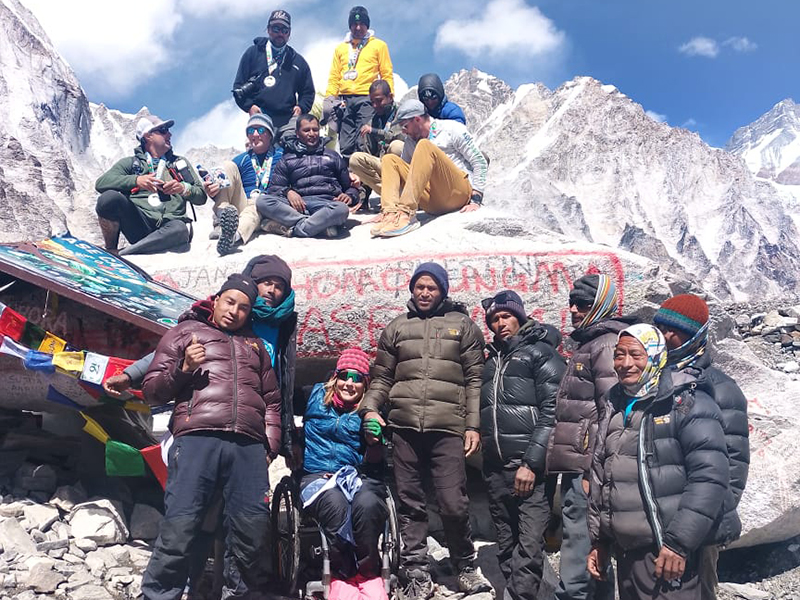
An incredible hike with an amazing group of people. Badri managed to get us in and out of Lukla on days when we thought flights may not be possible and he tried his very best to accommodate the needs of the group. The team of porters supporting Karen Darke were out of this world and did an incredible job, with big smiles. Wonderful people. The trek itself was incredible and we had fantastic weather during the whole trip. Although the ‘B Team’ snail ed it, we had an excellent adventure thanks to Badri and his very supportive team.
Teahouse Treks
Authentic Nepal Trekking
Everest Three Pass Trek – 19 Days
Everest Three Pass Trek Overview
The Everest Three Pass Trek is the ultimate Everest region adventure — a challenging and magnificent 19-day trekking circuit in Nepal that goes far beyond the standard Everest Base Camp route. It crosses three high Himalayan passes, visits Everest Base Camp and Kala Patthar, explores the turquoise Gokyo Lakes, and completes a full loop of the Khumbu region without retracing a single step.
The three passes are the heart of this trek. Kongma La at around 5,535m, Cho La at around 5,420m, and Renjo La at around 5,360m — each one a genuine high-altitude crossing with glaciers, moraine trails, and views that dwarf almost anything else in the trekking world. Between the passes, the route takes in Everest Base Camp at 5,364m, Kala Patthar at 5,545m, and Gokyo Ri at 5,357m — three of the finest viewpoints in the entire Himalayan range.
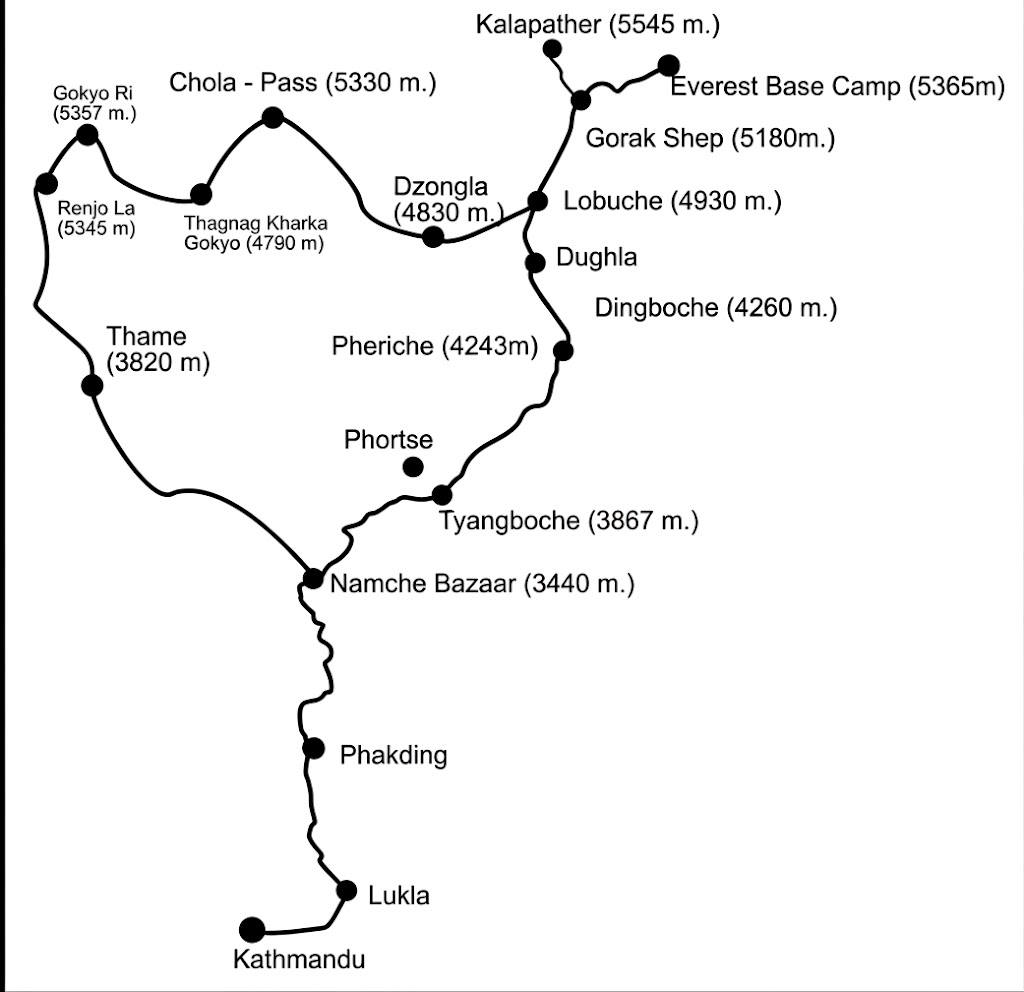
The trek begins with a scenic flight to Lukla and follows the classic Khumbu trail through Phakding, Namche Bazaar, and Tengboche before branching into the full circuit — Dingboche, Chhukung, Kongma La, Lobuche, Gorak Shep, Everest Base Camp, Kala Patthar, Dzongla, Cho La, Gokyo, Renjo La, Lungden, Thame, and back to Lukla. You walk through Sagarmatha National Park — a UNESCO World Heritage Site — the entire way.
The Everest Three Pass Trek is best suited to experienced trekkers and fit adventure travelers who want the most complete Khumbu experience available. If you want the classic route without the passes, our 14-day Everest Base Camp Trek is the right choice. For the Gokyo Lakes without the full circuit, see our Everest Gokyo Lake Trek.
The Trekking Route
The trek starts with a scenic flight to Lukla and follows the Dudh Koshi River valley through Phakding to Namche Bazaar — the legendary Sherpa capital of the Khumbu at 3,440m and the gateway to everything that follows. After an acclimatization day in Namche, the trail continues through Tengboche — home to the most atmospheric monastery in the region — and on to Dingboche and Chhukung.
The first pass, Kongma La at around 5,535m, is crossed from Chhukung — a demanding ascent over rocky moraine and glacial terrain with extraordinary views of Makalu, Lhotse, and the Khumbu Glacier below. The trail then descends to Lobuche and continues to Gorak Shep, Everest Base Camp, and the pre-dawn climb to Kala Patthar at 5,545m — the finest close-up view of Everest’s summit on earth.
From Gorak Shep, the route crosses Cho La Pass at around 5,420m — a steep and exposed crossing that requires care on the glaciated upper section — before descending to the magical Gokyo Valley with its chain of sacred turquoise lakes and the panoramic summit of Gokyo Ri at 5,357m, where Everest, Lhotse, Makalu, and Cho Oyu fill the horizon simultaneously.
The final pass, Renjo La at around 5,360m, completes the circuit — a high ridge crossing with sweeping views back over the Gokyo Lakes before the descent through Lungden and Thame to Lukla and the flight back to Kathmandu.
Everest Three Pass Trek Highlights
- Cross three high Himalayan passes — Kongma La (5,535m), Cho La (5,420m), and Renjo La (5,360m)
- Everest Base Camp at 5,364m / 17,598ft — the foot of the world’s highest mountain
- Kala Patthar at 5,545m / 18,192ft — the finest close-up view of Everest’s summit
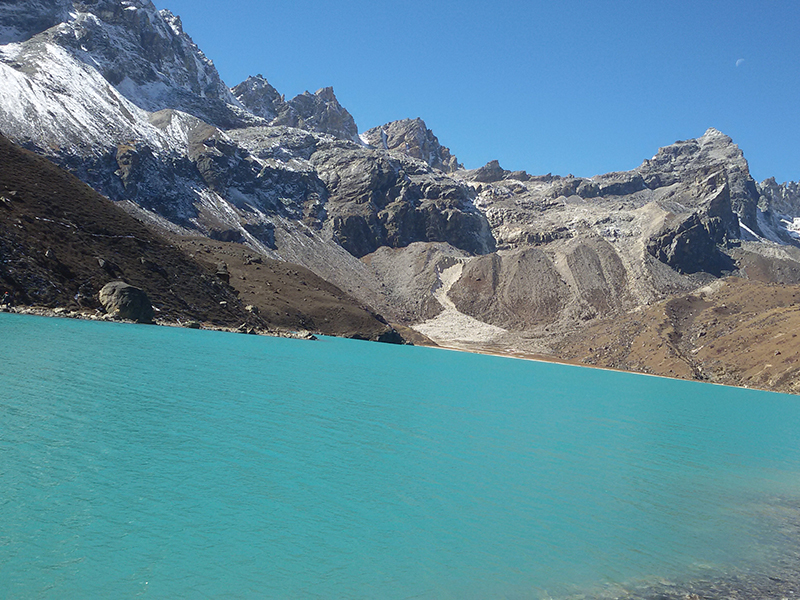
- Gokyo Lakes — a chain of sacred turquoise lakes in one of the most beautiful valleys in Nepal
- Gokyo Ri at 5,357m — panoramic views of Everest, Lhotse, Makalu, and Cho Oyu simultaneously
- Complete circuit of the Khumbu — no backtracking, no repeated trail sections
- Namche Bazaar — the legendary Sherpa capital of the Khumbu
- Tengboche Monastery — the most atmospheric setting on the entire route
- Walk beside the Khumbu Glacier and Ngozumpa Glacier
- Views of Everest, Lhotse, Nuptse, Makalu, Cho Oyu, Ama Dablam, and Pumori
- Experience Sherpa culture, prayer flags, mani walls, and monasteries throughout
- Tea house accommodation throughout the trek
Best Time for Everest Three Pass Trek
The best time for the Everest Three Pass Trek is spring and autumn.
Spring, from March to May, is one of the most rewarding seasons on this route. The weather is warmer, the rhododendron forests on the lower trail are in bloom, and Everest Base Camp is alive with expedition teams preparing for summit attempts. Pass conditions are generally good in May once the season is established.
Autumn, from September to November, is the most popular and reliable trekking season in Nepal. After the monsoon, the air is clean and crisp, the skies are consistently clear, and the views from all three passes and both high viewpoints are at their absolute best. October and November are the ideal months for this trek.
Trek Difficulty
The Everest Three Pass Trek is rated very challenging — the most demanding trek in the Everest region and significantly harder than the standard Everest Base Camp or Gokyo Lake routes. No technical climbing experience is required, but the combination of three high passes above 5,300m, long walking days, glacier crossings, and a 19-day commitment makes this a trek for experienced, well-prepared trekkers.
Trekkers should expect daily walking of 6 to 8 hours on rocky trails, moraine, glaciated terrain, and steep pass ascents and descents. Two acclimatization days are built into the itinerary — one in Namche Bazaar and one in Dingboche — and these are non-negotiable. The pass crossings demand good fitness, sure footing, and full confidence in your guide’s judgment on weather and conditions.
Walk slowly, stay well hydrated, eat well, and always follow your guide’s advice. If you are new to high altitude or have not completed a multi-day Himalayan trek before, start with our 14-day Everest Base Camp Trek first.
Permits Required
The Everest Three Pass Trek passes through Sagarmatha National Park, a UNESCO World Heritage Site, which requires a Sagarmatha National Park Entry Permit.
Trekkers also need a Khumbu Pasang Lhamu Rural Municipality Trek Card
A TIMS Card and licensed guide are also required under Nepal Tourism Board regulations. We arrange all permits, your licensed guide, Lukla flights, tea house accommodation, and full trek logistics before your trip begins — there is nothing you need to organise yourself before leaving home.
Trip Itinerary
Outline Itinerary
• Day 01: Arrival in Kathmandu
• Day 02: Fly to Lukla and Trek to Phakding
• Day 03: Trek from Phakding to Namche Bazaar
• Day 04: Acclimatization Day in Namche Bazaar
• Day 05: Trek from Namche Bazaar to Tengboche
• Day 06: Trek from Tengboche to Dingboche
• Day 07: Acclimatization Day in Dingboche
• Day 08: Trek from Dingboche to Chhukung
• Day 09: Cross Kongma La Pass and Trek to Lobuche
• Day 10: Trek to Gorak Shep and Visit Everest Base Camp
• Day 11: Hike to Kala Patthar and Trek to Dzongla
• Day 12: Cross Cho La Pass and Trek to Thagnak
• Day 13: Trek from Thagnak to Gokyo
• Day 14: Hike to Gokyo Ri and Explore Gokyo Lakes
• Day 15: Cross Renjo La Pass and Trek to Lungden
• Day 16: Trek from Lungden to Namche Bazaar via Thame
• Day 17: Trek from Namche Bazaar to Lukla
• Day 18: Fly from Lukla to Kathmandu
• Day 19: Final Departure
Details Itinerary
Day 01: Arrival in Kathmandu
Your adventure begins the moment you land at Tribhuvan International Airport. Our representative will be waiting to welcome you and transfer you to your hotel in Kathmandu — the vibrant, chaotic, and incredible gateway to the Himalayas.
Take some time to rest after your flight. In the evening, your guide will sit down with you for a trek briefing. This covers everything you need to know — the route, flights, permits, gear, weather, altitude safety, and daily walking plan. The mountains are waiting. Tomorrow, the journey truly begins.
• Altitude: Kathmandu – 1,300m / 4,260ft
• Transfer Time: Approx. 30–45 minutes
- Lodging: Hotel in Kathmandu
- Inclusions: Welcome Dinner
Day 02: Fly to Lukla and Trek to Phakding
Early in the morning, you will fly to Lukla. During peak season, the flight may operate from Manthali / Ramechhap. We will confirm the final flight plan.
After landing in Lukla, you will meet the trekking crew. From there, the trek begins with an easy walk toward Phakding. The trail passes small villages, prayer wheels, mani walls, and views of green hills.
This short first day helps your body adjust gradually to the mountain trail. But make no mistake — the adventure has already begun.
• Altitude: Lukla – approx. 2,840m / 9,318ft; Phakding – approx. 2,610m / 8,563ft
• Flight/Trek Time: Flight approx. 30–35 minutes; trek approx. 3–4 hours
- Lodging: Tea House / Lodge
- Inclusions: Breakfast, Lunch, Dinner
Day 03: Trek from Phakding to Namche Bazaar
After breakfast, you will follow the Dudh Koshi River valley on one of the most scenic stretches of the entire trek. The trail crosses several iconic suspension bridges and passes through villages such as Monjo and Jorsale — each one a window into traditional Sherpa mountain life.
You will enter Sagarmatha National Park near Monjo, a UNESCO World Heritage Site. After the permit check, the trail climbs steeply toward Namche Bazaar. On a clear day, you may catch your very first distant glimpse of Mount Everest — a moment that stops trekkers in their tracks every single time.
Namche Bazaar is the beating heart of the Khumbu region. It has lodges, shops, bakeries, cafés, and mountain views that will take your breath away. Welcome to the Everest region.
• Altitude: Namche Bazaar – approx. 3,440m / 11,286ft
• Trek Time: Approx. 5–6 hours
- Lodging: Tea House / Lodge
- Inclusions: Breakfast, Lunch, Dinner
Day 04: Acclimatization Day in Namche Bazaar
Today is an acclimatization day in Namche Bazaar. Rest does not mean staying in your lodge all day. Instead, you will take a short hike to help your body adjust and prepare for what lies ahead.
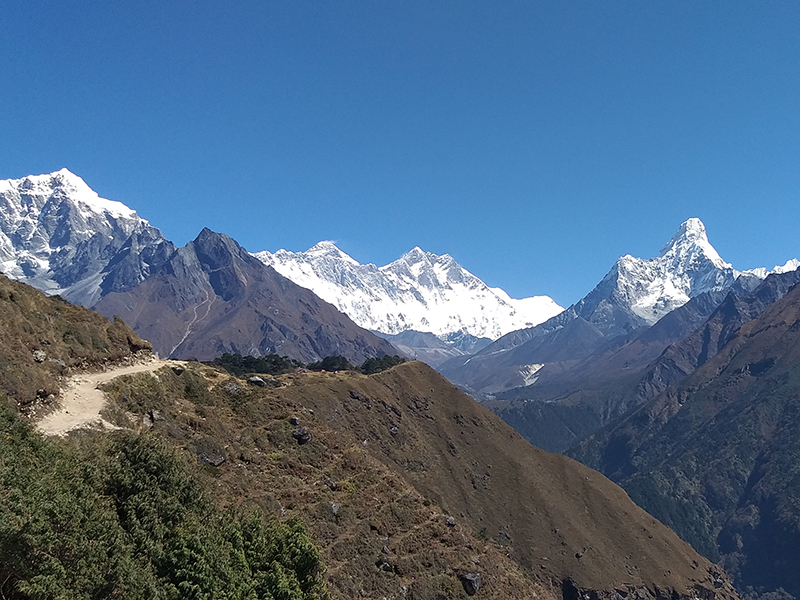
You may hike to Everest View Hotel, Syangboche, Khumjung, or Khunde. These places offer stunning views of Everest, Lhotse, Ama Dablam, Thamserku, and other peaks. This is your first real taste of the Himalayan giants — and it will leave you hungry for more.
After the hike, you will return to Namche. You can rest, explore the market, and prepare for the next trekking day.
• Altitude: Namche Bazaar – approx. 3,440m / 11,286ft
• Activity Time: Approx. 3–4 hours light hike
- Lodging: Tea House / Lodge
- Inclusions: Breakfast, Lunch, Dinner
Day 05: Trek from Namche Bazaar to Tengboche
After breakfast, the trail leaves Namche and follows a spectacular hillside route. This section rewards you with sweeping views of Everest, Lhotse, Ama Dablam, and Thamserku — a mountain panorama that few places on Earth can match.
The trail descends toward Phunki Tenga, then climbs through fragrant pine and rhododendron forests to Tengboche. Perched high above the valley with Ama Dablam rising dramatically behind it, Tengboche Monastery is one of the most photographed and most spiritual spots in all of Nepal. Standing here, with the mountains all around you and the sound of monks chanting inside the monastery walls, is an experience that stays with you long after the trek is over.
• Altitude: Tengboche – approx. 3,860m / 12,664ft
• Trek Time: Approx. 5–6 hours
- Lodging: Tea House / Lodge
- Inclusions: Breakfast, Lunch, Dinner
Day 06: Trek from Tengboche to Dingboche
Today, the landscape begins to change in a way that signals you are entering serious high-altitude territory. The trail descends from Tengboche through forest and crosses the Imja Khola, passing through the villages of Deboche and Pangboche.
As you climb higher, the trees thin out and the air grows cooler. The views of Ama Dablam, Lhotse, and the surrounding peaks become more dramatic with every step. Dingboche is a stunning high-altitude village that feels remote, wild, and completely unlike anywhere you have ever been. It is also a critical acclimatization stop — your body is preparing itself for what lies ahead.
• Altitude: Dingboche – approx. 4,410m / 14,469ft
• Trek Time: Approx. 5–6 hours
- Lodging: Tea House / Lodge
- Inclusions: Breakfast, Lunch, Dinner
Day 07: Acclimatization Day in Dingboche
Another acclimatization day — and another chance to push a little higher while letting your body catch up. At over 4,000 meters, this day is not optional. It is one of the most important days of the entire trek.
You will hike to Nangkartshang Hill or a nearby viewpoint. The effort is rewarded with jaw-dropping views of Ama Dablam, Makalu, Lhotse, Island Peak, and the vast Imja Valley spreading out below you. This is the kind of scenery that makes you stop walking just to stare.
After the hike, return to Dingboche, rest well, drink plenty of water, and get ready. Everest Base Camp is now just two days away.
• Altitude: Dingboche – approx. 4,410m / 14,469ft
• Activity Time: Approx. 3–5 hours light hike
- Lodging: Tea House / Lodge
- Inclusions: Breakfast, Lunch, Dinner
Day 08: Trek from Dingboche to Chhukung
After breakfast, the trail leaves Dingboche and follows the Imja Khola upstream into the Imja Valley — a narrowing glacial corridor that feels increasingly remote and high with every step. The path crosses stone-walled fields, passes through the yak herding settlement of Bibre, and enters glacier moraine terrain as the valley walls close in around you.
The views on this section are extraordinary. Lhotse’s immense south face dominates straight ahead, Island Peak — also known as Imja Tse — rises above the valley to the right, and Ama Dablam stands sentinel across the valley, its impossible profile reflected in the icy streams that cross the trail. The Amphu Labsa mountains fill the head of the valley beyond the village.
Chhukung sits at 4,730m — a small, quiet settlement of Sherpa tea houses surrounded on all sides by towering peaks and glaciers. It is the main base for Island Peak climbers and the staging point for the Kongma La crossing tomorrow. This is a deliberately short day — the altitude is serious now and arriving early gives your body extra time to rest before the first high pass. Nepal Trek Adventures
In the evening your guide will check weather conditions and confirm the plan for tomorrow’s crossing.
- Altitude: Chhukung – approx. 4,730m / 15,518ft
- Trek Time: approx. 3–4 hours
- Lodging: Tea House / Lodge
- Inclusions: Breakfast, Lunch, Dinner
Day 09: Cross Kongma La Pass and Trek to Lobuche
Start early — this is one of the hardest days of the entire trek, and an early departure is essential.
The trail climbs steeply northwest from Chhukung across boulder fields and glacial moraine, gaining altitude relentlessly as the Imja Valley falls away below. There are no tea houses between Chhukung and Lobuche — carry snacks, water, and full layers, and do not count on stopping anywhere until you reach the other side. The terrain is loose scree, rocky ridgeline, and potentially icy depending on season, and the trail demands full concentration throughout.
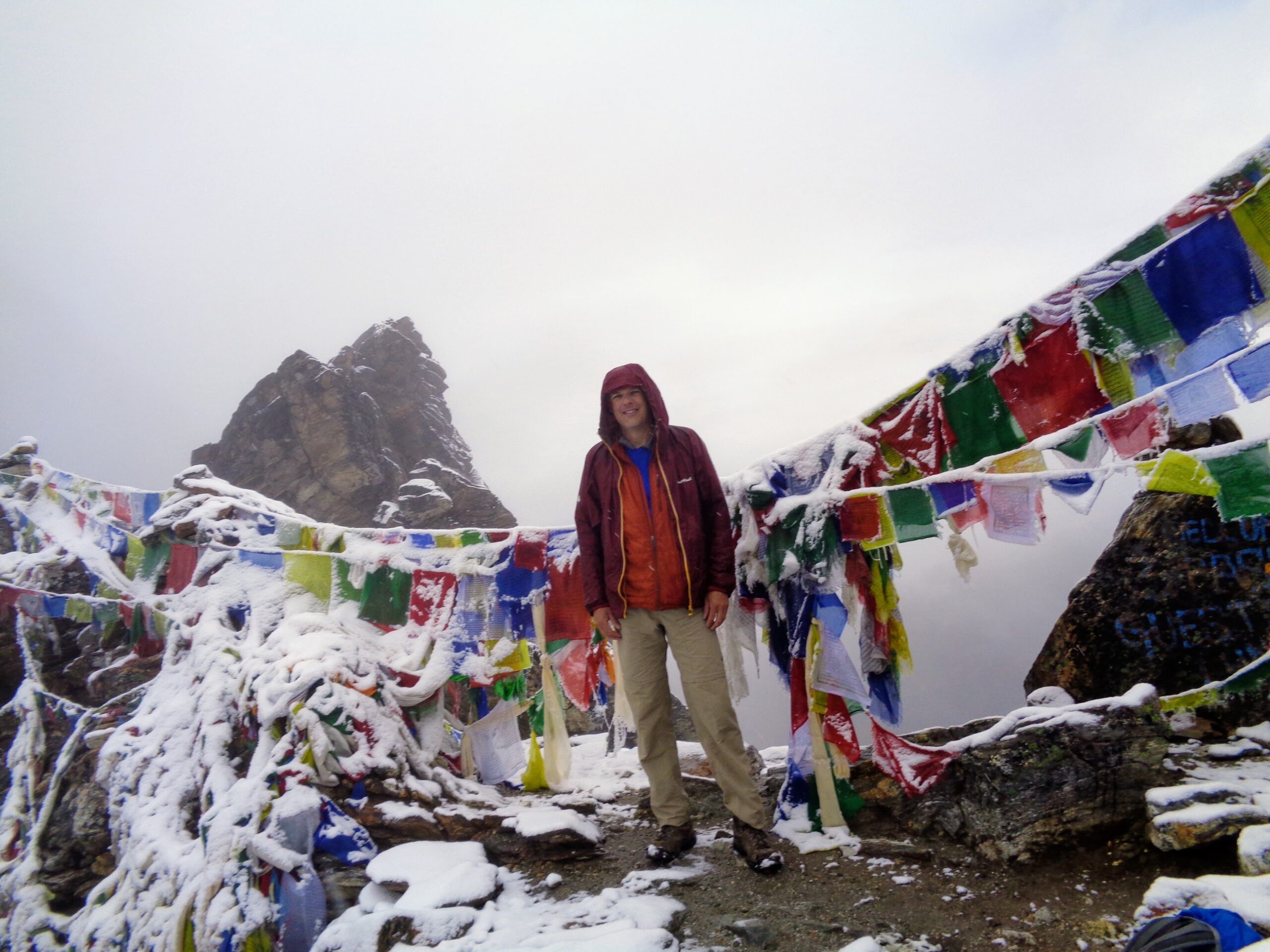
Kongma La Pass at 5,535m is the highest of the three passes and widely considered the most demanding day on the entire circuit. At the top, prayer flags mark the crossing and the views open in every direction — Lhotse, Makalu, Ama Dablam, Nuptse, and the vast white sprawl of the Khumbu Glacier laid out below you like a frozen river. Take a moment. You have earned it.
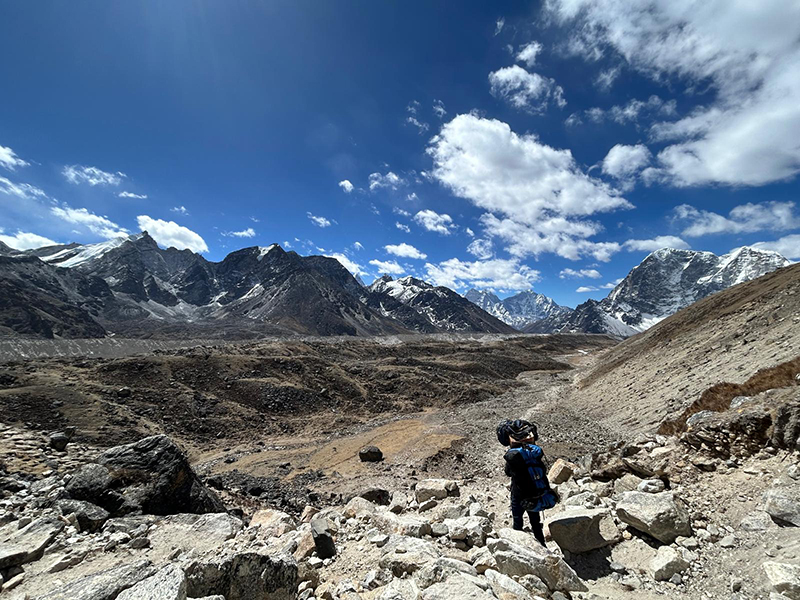
The descent is steep and unforgiving on the legs — and it ends with a crossing of the Khumbu Glacier itself, a raw traverse of ice and shifting moraine where the trail changes year to year as the glacier moves. Follow your guide without deviation on this section. Lobuche appears on the far side — a cluster of tea houses that will feel like the most welcome sight in Nepal.
- Altitude: Kongma La Pass – approx. 5,535m / 18,159ft
- Altitude: Lobuche – approx. 4,910m / 16,109ft
- Trek Time: approx. 8–10 hours
- Lodging: Tea House / Lodge
- Inclusions: Breakfast, Lunch, Dinner
Day 10: Trek to Gorak Shep and Visit Everest Base Camp
Day: Trek from Lobuche to Everest Base Camp via Gorak Shep
Start early. After yesterday’s crossing, the trail continues northwest from Lobuche along the lateral moraine of the Khumbu Glacier — a stark, otherworldly landscape of rock, ice, and frozen lakes that grows more dramatic with every step. The path is well-worn but uneven, and the altitude is now above 5,000m — walk slowly, breathe steadily, and let the mountain come to you.
Gorak Shep at 5,164m is the last settlement on the route — a handful of tea houses perched on an ancient glacial lake bed at the foot of Kala Patthar. Stop here for rest, hot food, and a final check of your layers before the push to Base Camp.
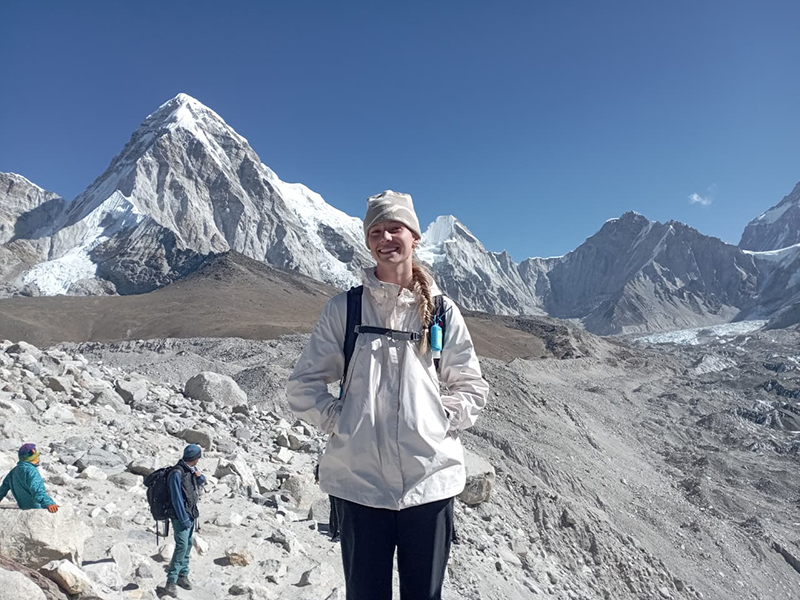
From Gorak Shep, the trail to Everest Base Camp follows the edge of the Khumbu Glacier for around two hours — a raw, magnificent walk across boulder fields and glacial moraine with the Khumbu Icefall visible ahead and the great ridgeline of Nuptse towering to the right. The ground shifts constantly underfoot and the trail requires careful attention. But then the prayer flags appear, and the cairns, and the feeling of standing at the foot of the world’s highest mountain settles over you in a way that is genuinely hard to describe.
Everest Base Camp at 5,364m is not a summit — but it is one of the great destinations on earth. Take your photos, take your time, and feel the weight of where you are. Then retrace the moraine trail back to Gorak Shep for the night.
- Altitude: Gorak Shep – approx. 5,164m / 16,942ft
- Altitude: Everest Base Camp – approx. 5,364m / 17,598ft
- Trek Time: approx. 7–8 hours total
- Lodging: Tea House / Lodge
- Inclusions: Breakfast, Lunch, Dinner
Day 11: Hike to Kala Patthar and Trek to Dzongla
The alarm goes off before dawn — for the third time on this trek, and for the best reason yet.
The climb from Gorak Shep to Kala Patthar takes around an hour and a half in the dark, headtorch on, the cold cutting through every layer as you gain the ridge. At 5,545m, Kala Patthar is the highest point of the entire trek — a rocky prominence above Gorak Shep that offers the finest close-up view of Everest’s summit available to any trekker on earth. As the sky lightens behind the ridge, Everest, Nuptse, Pumori, and Lingtren catch the first colour of dawn — gold, then white, then blazing against a deep blue sky. On a clear morning it is one of the great sights of the Himalayas.
Take your time at the top. Then descend back to Gorak Shep for a well-earned breakfast before the day’s walking begins in earnest.
From Gorak Shep, the trail retraces the moraine path back to Lobuche before branching west toward Dzongla — a quieter, less-travelled section of trail that leaves the main EBC route behind and heads toward the Cho La valley. The landscape is wide and exposed, the path skirting below the flanks of Cholatse as Dzongla comes into view — a small, isolated clutch of tea houses sitting in a high bowl above the glacier.
Rest well tonight. Cho La is tomorrow.
- Altitude: Kala Patthar – approx. 5,545m / 18,192ft
- Altitude: Dzongla – approx. 4,830m / 15,846ft
- Trek Time: approx. 7–8 hours total
- Lodging: Tea House / Lodge
- Inclusions: Breakfast, Lunch, Dinner
Day 12: Cross Cho La Pass and Trek to Thagnak
Start before dawn — the frozen snow makes the glacier crossing safer, and you want to be off the upper sections before the afternoon sun loosens the rocks above.
The trail climbs from Dzongla through rocky switchbacks and boulder-strewn chutes, gaining altitude steadily as the pass comes into view ahead. Then the glacier arrives — the Cho La Glacier, a permanent ice field that must be crossed before the final rocky scramble to the pass. The ice is usually crunchy and firm in the early morning — microspikes make this section significantly less taxing, and a fixed metal rope assists on the steepest section just below the summit. Follow your guide’s exact line without deviation — the glacier surface changes every season and crevasses are possible off the marked route. Going the Whole Hogg
Cho La Pass at 5,420m is marked by prayer flags and a rock cairn — a wide, flat saddle with views of Ama Dablam, Cholatse, Arakam Tse, and the Gokyo peaks opening to the west. For many trekkers, the Cho La crossing is the hardest and most memorable segment of the Three Passes — combining exposed high-altitude terrain, dramatic glacier features, sweeping alpine panoramas, and a genuine sense of remoteness. Discovery World Trekking
The initial descent is very steep and rocky, dropping around 250 metres with a fixed metal rope to assist on the worst of it. Below the steep section the trail eases through a boulder field and across the valley floor to Thagnak — a small, isolated settlement that serves as the staging point for the approach to Gokyo. Going the Whole Hogg
- Altitude: Cho La Pass – approx. 5,420m / 17,782ft
- Altitude: Thagnak – approx. 4,700m / 15,420ft
- Trek Time: approx. 7–9 hours
- Lodging: Tea House / Lodge
- Inclusions: Breakfast, Lunch, Dinner
Day 13: Trek from Thagnak to Gokyo
After breakfast, the trail heads northwest from Thagnak toward Gokyo — a shorter day that feels like a reward after the brutality of Cho La. The route crosses rocky terrain alongside the Ngozumpa Glacier — the longest glacier in Nepal — its vast grey moraine stretching away to the north as you pick your way carefully along the uneven path beside it.
The walking requires attention — the glacial terrain is rough and the ground shifts underfoot in places — but the pace is gentle and the valley ahead grows more beautiful with every step. Then the first lake appears, and the second, and finally Gokyo itself comes into view beside the third and most celebrated of the sacred lakes, Dudh Pokhari — its waters an extraordinary deep turquoise against the surrounding rock and ice.
Gokyo village sits at the edge of the lake at 4,790m — a cluster of stone tea houses in one of the most beautiful and remote settings in the Khumbu. Cho Oyu, the world’s sixth highest mountain, is reflected in the still water of the lake on calm mornings. Rest, eat well, and take in the remarkable stillness of this place. Gokyo Ri is tomorrow.
- Altitude: Gokyo – approx. 4,790m / 15,715ft
- Trek Time: approx. 3–4 hours
- Lodging: Tea House / Lodge
- Inclusions: Breakfast, Lunch, Dinner
Day 14: Hike to Gokyo Ri and Explore Gokyo Lakes
Wake before dawn one more time.
The climb from Gokyo village to Gokyo Ri takes around two hours — a steep, relentless ascent up the ridge above the lake that demands slow, deliberate pacing at this altitude. There are no shortcuts and no easy sections. But the summit at 5,357m delivers one of the most extraordinary panoramas in the entire Himalayan range.
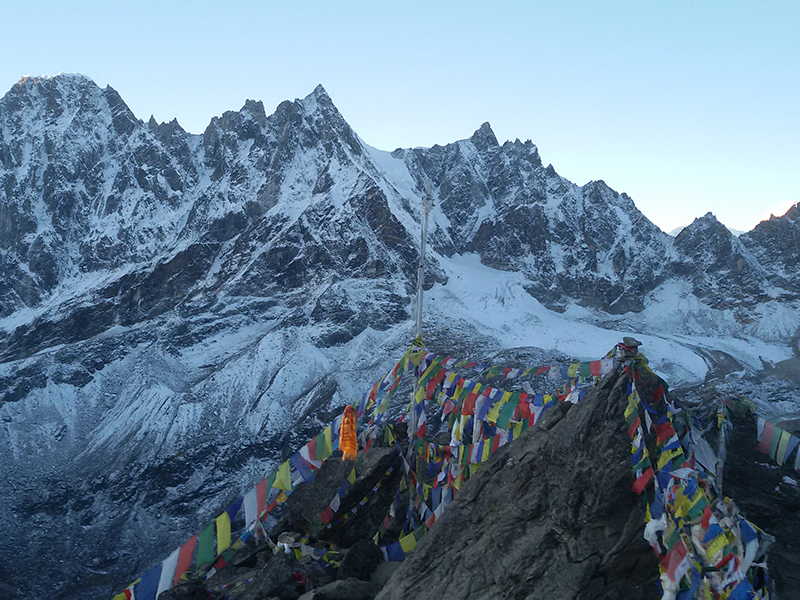
From the top, four of the world’s six highest mountains are visible simultaneously — Everest (8,848m), Lhotse (8,516m), Makalu (8,485m), and Cho Oyu (8,201m) — lined up across the horizon in a single sweeping view that stops even seasoned trekkers in their tracks. The Ngozumpa Glacier — Nepal’s longest — spreads out far below, and the chain of sacred Gokyo Lakes glitter in the early morning light beneath you. It is, by any measure, one of the great viewpoints on earth.
Return to Gokyo for a well-earned breakfast, then spend the rest of the day at your own pace. Walk the lake shore, explore the upper lakes if energy allows, or simply sit beside Dudh Pokhari and watch Cho Oyu’s reflection shift in the water. Tomorrow the third and final pass awaits — use today to rest properly.
- Altitude: Gokyo Ri – 5,357m / 17,575ft
- Altitude: Gokyo – approx. 4,790m / 15,715ft
- Trek Time: approx. 4–5 hours for Gokyo Ri hike
- Lodging: Tea House / Lodge
- Inclusions: Breakfast, Lunch, Dinner
Day 15: Cross Renjo La Pass and Trek to Lungden
Start early — the pattern holds for the third time, and for good reason.
The trail climbs steeply west from Gokyo, gaining the ridge above the lakes with a sustained ascent over rocky and grassy terrain. As you climb, the Gokyo Lakes appear below in sequence — their extraordinary turquoise colour deepening as the morning light strengthens — with Cho Oyu, Everest, and the full sweep of the high Khumbu range filling the horizon behind them. From the summit at 5,360m, the views stretch across several of the world’s highest peaks — Everest, Lhotse, Makalu, and Cho Oyu — in one of the most celebrated panoramas in the Everest region. The Everest Holiday
Renjo La is the lowest of the three passes and the only one that does not require a glacier crossing — which after Kongma La and Cho La will feel like a significant relief. The terrain is steep and rocky near the summit but presents no technical challenge under normal seasonal conditions. No fixed ropes, no glacier navigation — just a long, demanding climb that rewards with arguably the finest view of the entire circuit. Halfway Anywhere
The descent west toward Lungden is steep initially before easing into a remote, peaceful valley that feels entirely removed from the busier Everest Base Camp trail. The descent through Lungden and Thame takes you through real Sherpa country — less commercialized and rich in ancient traditions. Lungden is a quiet, isolated overnight stop — the third pass is behind you and the end of the circuit is within reach. Best Heritage Tour
- Altitude: Renjo La Pass – approx. 5,360m / 17,585ft
- Altitude: Lungden – approx. 4,380m / 14,370ft
- Trek Time: approx. 7–8 hours
- Lodging: Tea House / Lodge
- Inclusions: Breakfast, Lunch, Dinner
Day 16: Trek from Lungden to Namche Bazaar via Thame
After breakfast, the trail descends from Lungden through the remote Bhote Koshi valley toward Thame — one of the most culturally significant Sherpa villages in the entire Khumbu region. Thame sits quietly above the valley floor, its ancient monastery perched on the cliff face above the village, prayer flags strung across the hillside. This is the home village of Tenzing Norgay Sherpa, and the community has produced more high-altitude climbers than almost anywhere else on earth. Take a moment here before continuing.
From Thame, the trail descends steadily through mani walls, juniper forest, and river valleys — the air growing noticeably warmer and thicker with every hundred metres of descent. The Bhote Koshi river rushes alongside, the path crossing and recrossing as the valley widens toward the main Khumbu trail. After days on remote high passes with few other trekkers, the reappearance of the main route feels like returning to civilisation.
Namche Bazaar at 3,440m arrives like an old friend. The horseshoe-shaped Sherpa capital is as welcoming on the way out as it was on the way in — bakeries, hot showers, strong coffee, and the satisfaction of knowing that three of Nepal’s highest trekking passes are now behind you. Rest well tonight.
- Altitude: Namche Bazaar – approx. 3,440m / 11,286ft
- Trek Time: approx. 6–7 hours
- Lodging: Tea House / Lodge
- Inclusions: Breakfast, Lunch, Dinner
Day 17: Trek from Namche Bazaar to Lukla
Today is the final walking day of the Everest Base Camp Trek — and it deserves to be savored. You will descend from Namche through the Dudh Koshi River valley, crossing suspension bridges and passing through familiar villages on the way back to Lukla.
The trail that felt so new and exciting on Day 2 now feels like an old friend. After reaching Lukla, gather with your guide and porter team to celebrate one of the greatest things you have ever done. You trekked to Everest Base Camp. Not everyone can say that.
• Altitude: Lukla – approx. 2,840m / 9,318ft
• Trek Time: Approx. 6–7 hours
- Lodging: Tea House / Lodge
- Inclusions: Breakfast, Lunch, Dinner
Day 18: Fly from Lukla to Kathmandu
Early in the morning, you will fly from Lukla back to Kathmandu — or to Manthali if flights are operating from there, followed by a scenic drive back to the city. Either way, you are heading home from one of the world’s greatest adventures.
After arrival, transfer to your hotel. The rest of the day is yours — rest, explore Kathmandu, pick up last-minute souvenirs, or simply sit and reflect on everything you have just experienced. In the evening, enjoy a farewell dinner. You have earned every bite.
• Altitude: Kathmandu – 1,300m / 4,260ft
• Flight/Drive Time: Flight approx. 30–35 minutes; Manthali drive may take approx. 4–5 hours
- Lodging: Hotel in Kathmandu
- Inclusions: Breakfast, Farewell Dinner
Day 19: Final Departure
Your 19 Days Everest Three Pass Trek ends today— but the memories will last a lifetime. Our team will transfer you to Tribhuvan International Airport for your final departure.
If you are not ready to leave Nepal just yet, we do not blame you. Popular extensions include the Gokyo Lake Trek, Everest View Trek, Chitwan jungle safari, Pokhara tour, Annapurna Base Camp Trek, Bhutan tour, or Tibet tour. Nepal has a way of pulling you back — most people who come once find themselves planning their return before they even get home.
• Altitude: Kathmandu – 1,300m / 4,260ft
• Transfer Time: Approx. 30–45 minutes
- Lodging: Not Included
- Inclusions: Breakfast
Cost Details
Cost Includes
• Airport arrival and departure transfer More Info
• Hotel accommodation in Kathmandu More Info
• Welcome dinner in Kathmandu More Info
• Breakfast in Kathmandu More Info
• Kathmandu / Manthali to Lukla flight More Info
• Tea house / lodge accommodation during the trek More Info
• Breakfast, lunch, and dinner during trekking days More Info
• Licensed trekking guide More Info
• Trekking staff support based on group size
• Porter to carry your gear More Info
• Sagarmatha National Park permit
• Khumbu Pasang Lhamu Rural Municipality Trek Card
• TIMS Card as Required
• High-altitude safety guidance
• Basic first aid support
• Lukla to Kathmandu / Manthali flight More Info
• Ground transfer if flights operate from Manthali
• Hotel accommodation in Kathmandu More Info
• Farewell dinner in Kathmandu More Info
• Government taxes and official service charges
Cost Excludes
• 4% credit card fee for any portion of payment made by credit card. Cash or wire incurs no extra fees More Info
• Single guest supplement charge. Contact us for exact price More Info
• International airfare More Info
• Nepal visa fee More Info
• Travel insurance More Info
• Personal trekking equipment (rentals readily available for reasonable prices) More Info
• Lunch and dinner in Kathmandu unless mentioned More Info
• Drinks (except tea is included), snacks, hot shower (at higher elevations tea houses), Wi-Fi, battery charging, and personal expenses during trek More Info
• Tips for guide, porter, and trekking staff More Info
• Extra hotel nights caused by early arrival, late departure, flight delay, or weather condition More Info
• Extra cost caused by Lukla flight delay, cancellation, rerouting, or helicopter upgrade More Info
• Additional cost caused by landslide, snow, political strike, road blockage, or natural events More Info
• Emergency rescue, medical treatment, helicopter evacuation, or insurance claim cost More Info
• Any cost caused by itinerary change due to altitude sickness or weather More Info
• Any cost not mentioned in the Cost Includes section
FAQ
Everest Three Pass Trek
Is Everest Three Pass Trek good for beginners?
This trek is best for experienced trekkers. Fit beginners can do it with strong training. However, the three high passes make it very challenging.
How many days is this Everest Three Pass Trek package?
This is a 19-day Everest Three Pass Trek package. It includes arrival, Lukla flights, acclimatization days, three passes, Everest Base Camp, Gokyo Lakes, and final departure.
What are the three passes in Everest Three Pass Trek?
The three passes are Kongma La Pass, Cho La Pass, and Renjo La Pass. They are all high-altitude passes above 5,300 meters.
How high is Kongma La Pass?
Kongma La Pass is commonly listed around 5,535m / 18,159ft. It is often the first pass on the clockwise Everest Three Pass route.
How high is Cho La Pass?
Cho La Pass is commonly listed around 5,420m / 17,782ft. It connects the Everest Base Camp side with the Gokyo Valley side.
How high is Renjo La Pass?
Renjo La Pass is commonly listed around 5,360m / 17,585ft. It gives excellent views of Gokyo Lakes and the Everest range.
Does this trek include Everest Base Camp?
Yes. This trek includes Everest Base Camp and Kala Patthar. It also includes Gokyo Lakes and Gokyo Ri.
What is the best time for Everest Three Pass Trek?
The best time is spring from March to May and autumn from September to November. These seasons usually offer better weather and safer pass conditions.
What mountains can I see during the trek?
You can see Everest, Lhotse, Nuptse, Makalu, Cho Oyu, Ama Dablam, Pumori, Thamserku, Kangtega, and other peaks of the Khumbu region.
Is Everest Three Pass Trek difficult?
Yes. It is one of the most challenging tea house treks in Nepal. The route includes high altitude, long walking days, rocky trails, snow, glacier moraine, and three high passes.
Do I need permits for Everest Three Pass Trek?
Yes. You need the Sagarmatha National Park Entry Permit, Khumbu Pasang Lhamu Rural Municipality Trek Card, and TIMS Card as per current rules.
Do I need a guide for Everest Three Pass Trek?
Yes. A licensed guide is strongly recommended and required under current guide/TIMS rules for listed Everest region routes. A guide is also very important for high pass safety.
What kind of accommodation is available?
Accommodation during the trek is in local tea houses and mountain lodges. In Kathmandu, accommodation is arranged in a hotel.
Do I need travel insurance?
Yes. Travel insurance is strongly recommended. It should cover trekking above 5,000 meters, medical care, trip delay, and helicopter evacuation.
Can I book a private Everest Three Pass Trek?
Yes. This trek can be arranged as a private guided trek. It can be customized based on your date, budget, fitness level, and group size.
Can I customize this 19-day itinerary?
Yes. You can add extra acclimatization days, add helicopter return, add a rest day in Gokyo, or make the trek slower for better comfort.
Route Map
Gallery
Client Reviews
Mitchedberg
Vicky S
Date of experience: March 2025
Clare B
Date of experience: March 2025
An amazing experience – went trekking with 14 others in March / April 2025 and had a wonderful time. A big thank you to Badri and his crew for taking care of every logistical detail; flights, hotels, transportation in Kathmandu, transportation to and from the airport, money exchanges, restaurant reservations, sightseeing, optimal route pacing, gear transportation, and 100 other small details that would have left me flummoxed.
He and his team allow for a trek that’s as simplified as possible, you can focus your energy on getting to base camp, and they do everything else. They even bring you hot towels and lemon ginger tea at the end of each day (every morning too). I can’t say enough good things about the porters / guides, they were unbelievable, true heroes of our trip. We had some very unique challenges in our group, and without expert guides and porters we would absolutely not have had the same high quality experience. When I go back to Nepal for a second trek, I’m calling Badri. Badri is the guide you want – generous, personal, and you can tell he and his team deeply care about the well-being of their clients.
One more thing: Not once, but twice, Badri got our entire group flown from Kathmandu to Lukla (and back) on days when the weather was uncooperative. Both times, there was only a brief window when the clouds cleared — just enough for a single plane to make the journey — and guess whose plane was first in line? Even more impressive: while we were waiting at the airport, Badri already had a backup helicopter option lined up, just in case the planes didn’t fly. This kind of foresight and preparation gave us total peace of mind.