The Real Truth Behind Nepal Trekking Company Pricing
Nepal trekking company pricing is confusing by design — and that confusion costs people more than money. I’ve trekked Nepal four times — Everest Base Camp twice, the Annapurna Circuit, and the Three Passes — and I’ve seen the mountains from every angle: as a trekker, and now as the US co-founder of a joint venture trekking company built around a partner who has spent over 20 years operating in the Himalayas. That combination gives me a perspective on pricing that most people in this industry won’t share openly.
So let me share it.
Every Nepal Trekking Company Faces the Same Hard Costs
Here’s what most people don’t realize when they’re comparing prices across websites: the hard costs of running an EBC trek are essentially fixed. They don’t change based on which company you book with. The mountain doesn’t offer discounts.
For a standard 14-day Everest Base Camp trek with two trekkers — the most common booking scenario — a legitimate operator is looking at roughly the following per person:
- Lukla flights (round trip): ~$600 per person
- Licensed trekking guide (14 days): Guide daily wages, food, accommodation, and insurance — costs shared across the group
- Guide’s Lukla flight (round trip): ~$100 total, shared across the group — on some treks the guide is already based in the region and joins at the trailhead, removing this cost entirely
- Porter (14 days): One porter typically serves two trekkers — their wages, food, and accommodation split accordingly (~$140–$175 per person)
- Sagarmatha National Park permit: ~$30
- Khumbu Pasang Lhamu municipality permit: ~$20
- TIMS card: ~$20
- Kathmandu hotel (2–3 nights, 3-star): ~$60–$90
- Welcome and farewell dinners: ~$30–$40
- Airport transfers: ~$15–$20
- Tea house accommodation (12 trekking nights): ~$60–$120
- All meals on trek (breakfast, lunch, dinner × 12 days): ~$180–$250
- Company overhead, admin, communications: variable
Add it up conservatively and you’re looking at a genuine cost floor of around $1,350–$1,600 per person for two trekkers — before the company makes a single dollar of profit. Solo trekkers pay a supplement precisely because several of the biggest costs don’t halve when there’s only one of you. A licensed guide is a licensed guide whether he’s walking with one person or two — his wage, his flight, his food and accommodation are the same. A private room in Kathmandu is a private room. A tea house room on the trail is a tea house room. None of those costs split in half just because you’re traveling alone. The single supplement exists to cover the fixed costs that a second trekker would otherwise share.
Our standard EBC price is $1,650 per person. That is not a high-margin business.
Nepal Trekking Company Pricing: The Inclusions Shell Game
Before you can even compare Nepal trekking company pricing between operators, you have to decode what’s actually included — and this is where the real confusion begins.
Some companies advertise a price that includes:
- Hotel in Kathmandu ✓
- Welcome and farewell dinners ✓
- All permits ✓
- All meals on trek ✓
- Guide, porter, transfers ✓
Others advertise a lower headline price that excludes the hotel, the dinners, or the meals — then list those as “optional extras.” Suddenly that cheaper package isn’t cheaper at all. You’re just comparing apples to a handful of seeds.
The most common exclusions used to artificially lower advertised prices:
- Hotel nights in Kathmandu — add $60–$90 per person minimum
- Welcome/farewell dinners — add $30–$40
- Meals on trekking days — at $25–$40 per day per person, excluding meals from a 12-day trek changes the real cost by $300–$480
- Lukla flights — some “budget” packages require you to arrange your own, removing ~$600 from the listed price
- Porter support — listed as optional or excluded entirely
I built our Everest Base Camp Budget Trek for exactly this reason — to offer a genuinely lower-cost option for experienced, independent-minded trekkers who are comfortable arranging their own Lukla flights and don’t need airport transfers or Kathmandu nights included. The guide meets you at the Lukla airstrip. It starts at $925 and it’s honest about what that means.
But even then, companies are advertising cheaper. And that’s where it gets uncomfortable.
I Did the Math for a Competitor
A few months ago I came across a company advertising an EBC trek at a price that didn’t add up to me. So I contacted them and asked why their price was so low. The owner told me he didn’t want to overcharge his customers.
I sent a follow-up email. I laid out every line item — flights, guide wages, permits, accommodation, meals, transfers — the real cost of running the trek they were selling. His advertised price left him losing $685 on every booking.
He didn’t respond.
I don’t think he was a bad person. I think he either didn’t fully understand his own costs, or he was hoping volume would somehow make it work. It won’t. And the people who suffer when a company runs at a loss aren’t the company owners — they’re the guides and porters who get paid less, the tea houses that don’t get paid at all, and eventually the trekkers who find themselves on a mountain with under-resourced support.
The GetYourGuide Problem
Over 3,000 trekking companies are registered in Nepal, all competing on Nepal trekking company pricing. Most of them need customers badly. Platforms like GetYourGuide offer visibility — but at a price. The commission GetYourGuide charges suppliers is typically around 20% of the booking value. Their standard payout to vendors is monthly. If you need your money sooner — say, because you need it to actually pay for the trek you just sold — you can request a twice-monthly payout, but that comes with an additional surcharge.
Think about what that means for a company operating on a margin of $50–$150 per booking. A 20% commission doesn’t come out of profit. It comes out of the price they quoted you. Something has to give — and it’s usually the guide’s wages, the porter’s load limit, or the quality of the tea house they’re booking you into.
And here’s the cash flow reality that almost nobody talks about: the majority of trekking companies in Nepal have no meaningful cash reserves. They use the customer’s payment to fund the trek. If GetYourGuide pays monthly, that company is operating on credit — borrowing against a trek they haven’t run yet, hoping nothing goes wrong. When something does go wrong — a Lukla delay, a medical evacuation, an extra hotel night — there is nothing in reserve to cover it.
This is not a hypothetical problem. It’s the structural reality of the industry. It’s also not theoretical — there’s a story making headlines out of Everest right now about a guide left to fend for himself for nearly a week after a client’s descent went wrong with an underresourced operator. The mountain doesn’t care how much you paid, but a company’s capacity to respond when something goes wrong
What a Legitimate Price Actually Buys You
I’m not saying you should pay the highest price you can find. I’m saying you should understand what a realistic Nepal trekking company pricing structure actually means.
A legitimate EBC package priced between $1,650 and $1,800 per person:
- Pays a licensed, government-certified guide a fair daily wage
- Keeps porter loads within ethical limits and provides proper gear
- Covers all required permits (no surprise fees at trail checkpoints)
- Includes Kathmandu hotel, welcome dinner, farewell dinner, and transfers
- Pays for Lukla flights in both directions
- Includes all meals while on trek
- Gives the company a thin but real margin — though be aware that weather delays, extra hotel nights, and other unexpected costs are charged separately by every legitimate operator, not just us. That’s not a hidden fee — it’s the reality of operating in the Himalayas
A package priced at $900 for the same trek either excludes most of the above, or someone is losing money to get your booking.
A Note on Our Own Budget Trek
We created our Everest Base Camp Budget Trek specifically to serve experienced, independent-minded trekkers who want a legitimate, licensed, guided experience at the lowest honest price we can offer. It starts at $925 per person.
Here’s what makes it different from the “cheap” packages you’ll find elsewhere: it’s genuinely honest about the trade-offs. You arrange your own Lukla flights. The guide meets you at the airstrip — he doesn’t accompany you from Kathmandu. There’s no welcome dinner, no airport transfer, no Kathmandu hotel included. These aren’t hidden surprises. They’re the explicit structure of the package.
What is included: a licensed, government-certified guide for the full trek on trail, all required permits, all tea house accommodation, and all meals on trekking days. The guide who meets you in Lukla is the same caliber as the one on our standard package. No corners cut where safety is concerned.
If you want to know exactly what’s in a package, ask. Any legitimate company should be able to give you a line-by-line breakdown without hesitation. If they can’t — or won’t — that’s your answer.
The Bottom Line
Nepal has over 3,000 registered trekking companies competing for the same pool of international trekkers. The pressure to undercut on Nepal trekking company pricing is enormous and relentless. The companies that survive by cutting prices do so by cutting something else — wages, safety margins, insurance, quality of support.
The mountains don’t care how much you paid. But at 5,300 meters, with a medical emergency unfolding, the quality of your guide’s training, the depth of his local relationships, and the financial capacity of his company to get you out — those things matter enormously.
I’ve seen it firsthand. When Lukla was grounded and every trekker in the region was trying to get a helicopter at the same time, the situation was the same for everyone — they all had licensed guides, as required by law. Having a guide gets you on the trail. It doesn’t get you a helicopter when every seat is spoken for. Badri had one sitting and waiting for us. His contacts — built over 20 years on the ground in Nepal — had that helicopter secured before most trekkers even knew flights were cancelled. Everyone else was standing in the same queue with the same guide, going nowhere. That kind of relationship isn’t something you can buy for $400, and it isn’t something that comes with a licence — it comes with two decades of showing up, doing the work, and earning the trust of the people who actually run things on the ground.
Book the company that can tell you, line by line, exactly where your money goes. You’ll be glad you did.
Glenn is the US-based co-founder of Tea House Treks and a four-time Nepal trekker. Badri Pant, our Nepal-based operations lead, has over 20 years of Himalayan experience. Browse our treks or contact us with any questions.
Travel Blogs
Stay Informed about travel information and latest updates
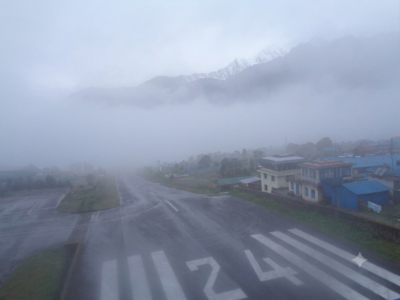
The Day a Hundred People Missed Their Flight Out of Lukla — and We Didn’t
It was October 2023, near the end of an Everest Base Camp trek. I had an international flight home in two days. That's a tight…
The Real Truth Behind Nepal Trekking Company Pricing
Nepal trekking company pricing is confusing by design — and that confusion costs people more than money. I've trekked Nepal four times — Everest Base…